
A Bridge on Economic Issues between China and the World



 Facebook
  Twitter
  Instagram
 WeChat
  Email
Email Conceptual and Empirical Understanding of the Dynamics of Skill Formation
An analysis of high-frequency data from a large early childhood intervention in China documents the existence of dynamic complementarity and the emergence of new skills over the life-cycle. Dynamic complementarity is a central concept in human development. It characterizes how early learning experiences affect subsequent learning and achievement. Dynamic complementarity and its components do not operate uniformly across ages, skill levels, or ability groups. New skills emerge over the life-cycle explaining fadeout when a measuring instrument is used that does not recognize the emergence of new skills.

Understanding Dynamic Complementarity and the Importance of the Emergence of New Skills
Dynamic complementarity concerns rates of learning: earlier investment makes later investment more effective. It is related to core policy questions: whether those exposed late to learning environments can catch up with those who start early, and how to shape education policies across different stages of the life-cycle. This question is especially important for disadvantaged children in rural China, where parental migration, grandparent caregiving, and uneven home learning environments shape learning long before children enter school.
Dynamic complementarity varies across different skill levels and ability groups. It arises from three sources: (a) static complementarity of investment with skill; (b) depreciation or appreciation of skills after investment is made; and (c) productivity of investment. Dynamic complementarity differs from static complementarity, which is the relationship that higher levels of current skills boost learning from current investments. Dynamic complementarity is also a distinct notion from the concept that early investment increases the stock of skills at later ages.
Our analysis also sheds light on fadeout—a big puzzle in education research (Bailey, 2020). Heckman and Zhou (2026) show that new skills emerge at each developmental stage, often qualitatively different from previous skills, and their evolution has a random component. Measuring skills over time using a common scale distorts how we measure human development and can lead to apparent fadeout when, in fact, new skills are being measured on inappropriate scales.
Empirical Evidence from China REACH
Our data come from a large-scale experimental evaluation of the China Rural Education and Child Health (China REACH) program, conducted by the China Development Research Foundation (CDRF). The intervention promotes multidimensional child development through home visits. It gives lessons to parents or caregivers who then teach children. Trained home visitors visit each treated household weekly and provide one hour of age-specific caregiving guidance to caregivers and also assess the skills of children. Zhou et al. (2026) show that the intervention significantly improves skill development (e.g., language and cognitive skills).
The China REACH curriculum is age-specific. All caregivers receive the exact same lesson when their child is at a specific weekly age. However, children in treatment villages enter the program at different ages. They miss training in all tasks that are designed for children younger than their age of enrollment. Thus, at the same age, some children receive more prior exposure to the program than others (see Figure 1 for enrollment time frame with two examples). This variation allows us to ask whether children with more prior investment learned subsequent material more rapidly, and it allows us to test dynamic complementarity directly.
Figure 1. China REACH Calendar Time Scales

Skills are ordered by difficulty levels based on the profiles developed by Palmer (1971) and Uzgiris and Hunt (1975) – profiles that are widely used in child development research. The scales of skills we use describe levels of knowledge with content that is the same within each level and across all children of the same age at that level. There is no hierarchy of tasks within levels. There are eleven different difficulty levels for language skills. Language skill tasks increase in difficulty with the expectation that the child will learn to identify and use expressive language to indicate understanding.
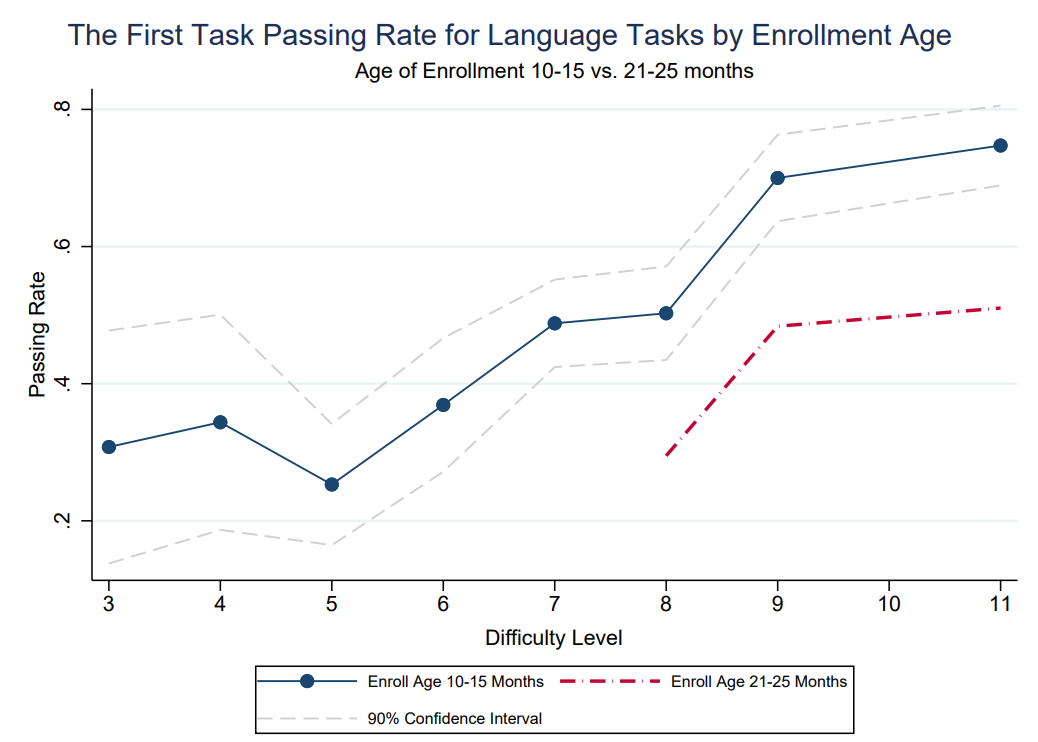
A simple way to test dynamic complementarity is to classify children into three groups based on their monthly age at enrolment (i.e., age 10–15, age 16–20, and age 21–25) and, hence, their exposure to the program's investment. We then compare children’s passing rates on the first tasks across the three groups. This is a measure of initial learning rate at each level, which is used to test dynamic complementarity. This is illustrated in Figure 2 (a)-(b). Later starters are slower learners.
Figure 2.The Learning Rate (Passing Rate) on the First Task for Language and Cognitive Tasks by Level and Enrollment Age
(a) Language: Age (10-15) vs. Age (21-25)
(b) Cognitive: Age (10-15) vs. Age (21-25)
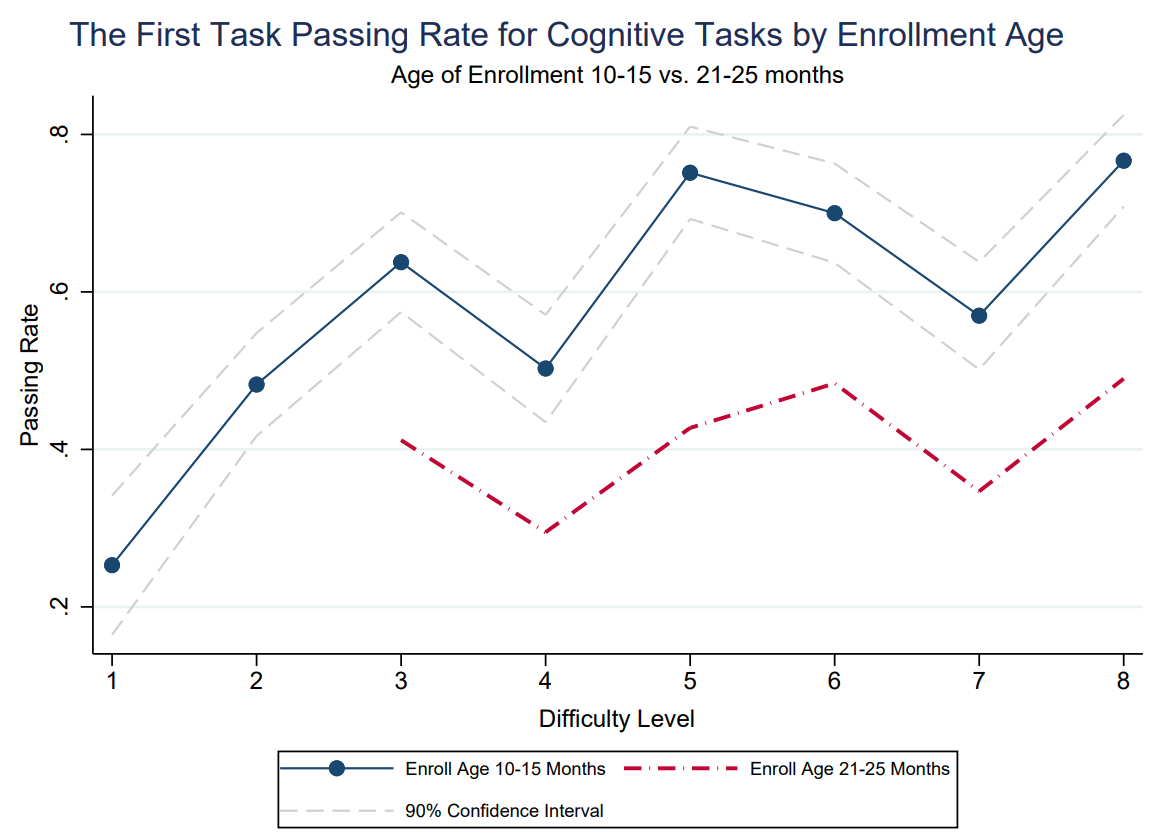
For initially low-ability groups in both cohorts (children who had full exposure of language levels versus children enrolled at level 6), the difference in learning rates at later levels is pronounced relative to higher-ability groups (Heckman et al., 2026). Disadvantaged children benefit the most in the early stages through dynamic complementarity, and starting early reduces gaps at later ages relative to higher-ability children and children in better learning environments.
Summary
We use granular weekly data and provide non-parametric evidence for dynamic complementarity using exogenous age-of-entry variation in a well-implemented RCT: the China REACH project. We avoid use of arbitrary scales for skills in deriving these results. Dynamic complementarity does not operate uniformly. Effective early childhood policy identifies sub-populations for whom dynamic complementarity has the greatest room to operate.
Reference
Bailey, D H, G J Duncan, F Cunha, B R Foorman, and D S Yeager (2020), “Persistence and fade-out of educational-intervention effects: Mechanisms and potential solutions,” Psychological Science in the Public Interest, 21(2): 55–97.
Heckman, J J, H Tian, Z Zhang, and J Zhou (2026), “Dynamic complementarity,” American Economic Journal: Applied Economics, forthcoming.
Heckman, J J, and J Zhou (2026), “A study of the microdynamics of early childhood learning,” Journal of Political Economy, 134(1): 49–85.
Palmer, F H (1971), Concept training curriculum for children ages two to five, State University of New York at Stony Brook.
Uzgiris, I C, and J M Hunt (1975), Assessment in infancy: Ordinal scales of psychological development, University of Illinois Press.
Zhou, J, J J Heckman, B Liu, and M Lu (2026), “The impacts of a prototypical home visiting program on child skills,” Journal of Labor Economics, 44(1): 119–148.

Latest
Most Popular
- VoxChina Covid-19 Forum (Second Edition): China’s Post-Lockdown Economic Recovery VoxChina, Apr 18, 2020
- China’s Great Housing Boom Kaiji Chen, Yi Wen, Oct 11, 2017
- China’s Joint Venture Policy and the International Transfer of Technology Kun Jiang, Wolfgang Keller, Larry D. Qiu, William Ridley, Feb 06, 2019
- The Dark Side of the Chinese Fiscal Stimulus: Evidence from Local Government Debt Yi Huang, Marco Pagano, Ugo Panizza, Jun 28, 2017
- Wealth Redistribution in the Chinese Stock Market: the Role of Bubbles and Crashes Li An, Jiangze Bian, Dong Lou, Donghui Shi, Jul 01, 2020
- Evaluating Risk across Chinese Housing Markets Yongheng Deng, Joseph Gyourko, Jing Wu, Aug 02, 2017
- Daily Price Limits and the Magnet Effect Ting Chen, Zhenyu Gao, Jibao He, Wenxi Jiang, Wei Xiong, Oct 25, 2017
- What Is Special about China’s Housing Boom? Edward L. Glaeser, Wei Huang, Yueran Ma, Andrei Shleifer, Jun 20, 2017
- Privatization and Productivity in China Yuyu Chen, Mitsuru Igami, Masayuki Sawada, Mo Xiao, Jan 31, 2018
- How did China Move Up the Global Value Chains? Hiau Looi Kee, Heiwai Tang, Aug 30, 2017