
A Bridge on Economic Issues between China and the World



 Facebook
 Twitter
 Instagram
 WeChat
 Email
Who Entered Industry When China Opened? Not the Examination Elite
When treaty ports opened late-Qing China to modern business, did the country’s educated elite rush into industry—or only part of it? Using a new bibliometric measure of regional scholarship and the staggered opening of ports, we show that upper-tail human capital significantly boosted modern firm creation, yet the margin came chiefly from literati with weak or no Imperial Ex-amination (Kējǔ) credentials, not from the examination’s highest achievers. Before the Kējǔ was abolished in 1905, industrialization drew on a vast pool of latent scholarly talent that meritocratic officialdom had left outside the bureaucracy.

This research is motivated by a nuanced paradox: civil service examinations can raise bureaucratic quality yet also skew careers when government service is disproportionately rewarded (Murphy et al. 1991, Acemoglu 1995, Geromichalos and Kospentaris 2022). Much empirical work stresses their benefits for state capacity (e.g., Besley et al. 2022, Aneja and Xu 2024, Moreira and Pérez 2024); less is known about which educated elites enter new productive sectors when those sectors open. We study late-Qing China (1840–1904), when treaty ports exposed intellectuals to industrial careers outside the Imperial Examination (Kējǔ)–officialdom path for the first time in over a millennium. Exploiting the staggered opening of treaty ports in a difference-in-differences design, we ask not only whether upper-tail human capital was mobilized into modern firms, but—our central finding—which strata of the literati made that move while the examination system was still in force.
Data: Quantifying human capital
A central challenge in studying talent allocation in historical settings lies in data availability. Prior studies of historical China have relied mainly on Shēngyuán quotas and Jìnshì counts, but the Kējǔ was extraordinarily selective. By 1850, only 1.5% of the two million examination candidates (from a population of 410 million) attained Shēngyuán status. Of these, about 5% passed the provincial exam, and fewer than 20% of the remaining candidates attained the Jìnshì degree—in effect, roughly one in 6,000 candidates, or about one person per two million inhabitants (Elman 1991). Administrative measures therefore capture only a thin slice of the literati, so we need a proxy for intellectual activity beyond formally credentialed elites.
We construct a bibliometric catalog of books authored before 1912, combining official bibliographies in the Twenty-Five Histories with modern library holdings, linked to author biographies and classified by field. Figure 1 maps prefecture-level book production from 1644 to 1840, our baseline stock measure.
Figure 1. Spatial Distribution of Books (1644–1840).
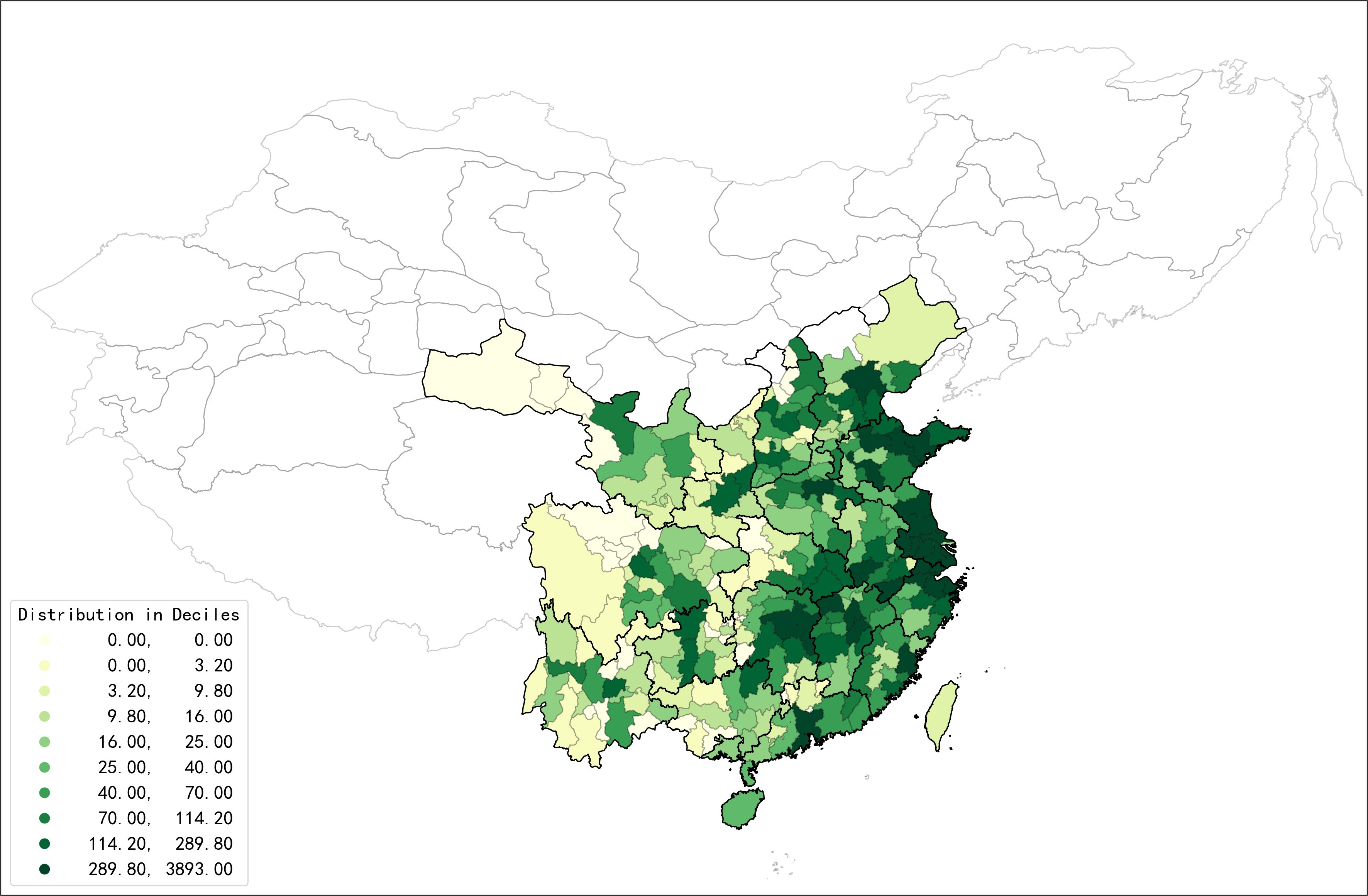
This map plots the geographic distribution at the prefecture-level of the total number of books written between 1644 and 1840.
Between 1644 and 1840, the average prefecture recorded 144.7 books, 70.2 Jìnshì graduates, and a Shēngyuán quota of 109.1; books per capita and Jìnshì per capita correlate at 0.666. This indicates that while our book metric reliably reflects the geographic distribution of top-tier elites, it captures a broader, more continuous spectrum of regional intellectual activity.
Empirical findings
Our empirical analysis is based on a panel dataset covering 267 prefectures within China proper from 1840 to 1904—the final 65 years of the Kējǔ. We employ a staggered difference-in-differences design, utilizing the canonical two-way fixed effects model alongside stacked regressions and the doubly robust estimator by Callaway and Sant’Anna (2021) to address recent methodological concerns. Our core question is who within the upper tail moved into industry. We first establish that such reallocation occurred in the aggregate, estimating:

The coefficient β on ln(BookDensi) × PostPorti,t measures how treaty-port opening differentially affected firm entry according to a prefecture’s pre-1840 book density. β is positive and significant throughout: a one-standard-deviation increase in book density raised firm creation by 0.132 standard deviations initially and by 1.231 by the end of the sample—confirming that opening drew latent scholarly human capital into modern firm creation.
Figure 2. Firm Creations and Book Density over Time.
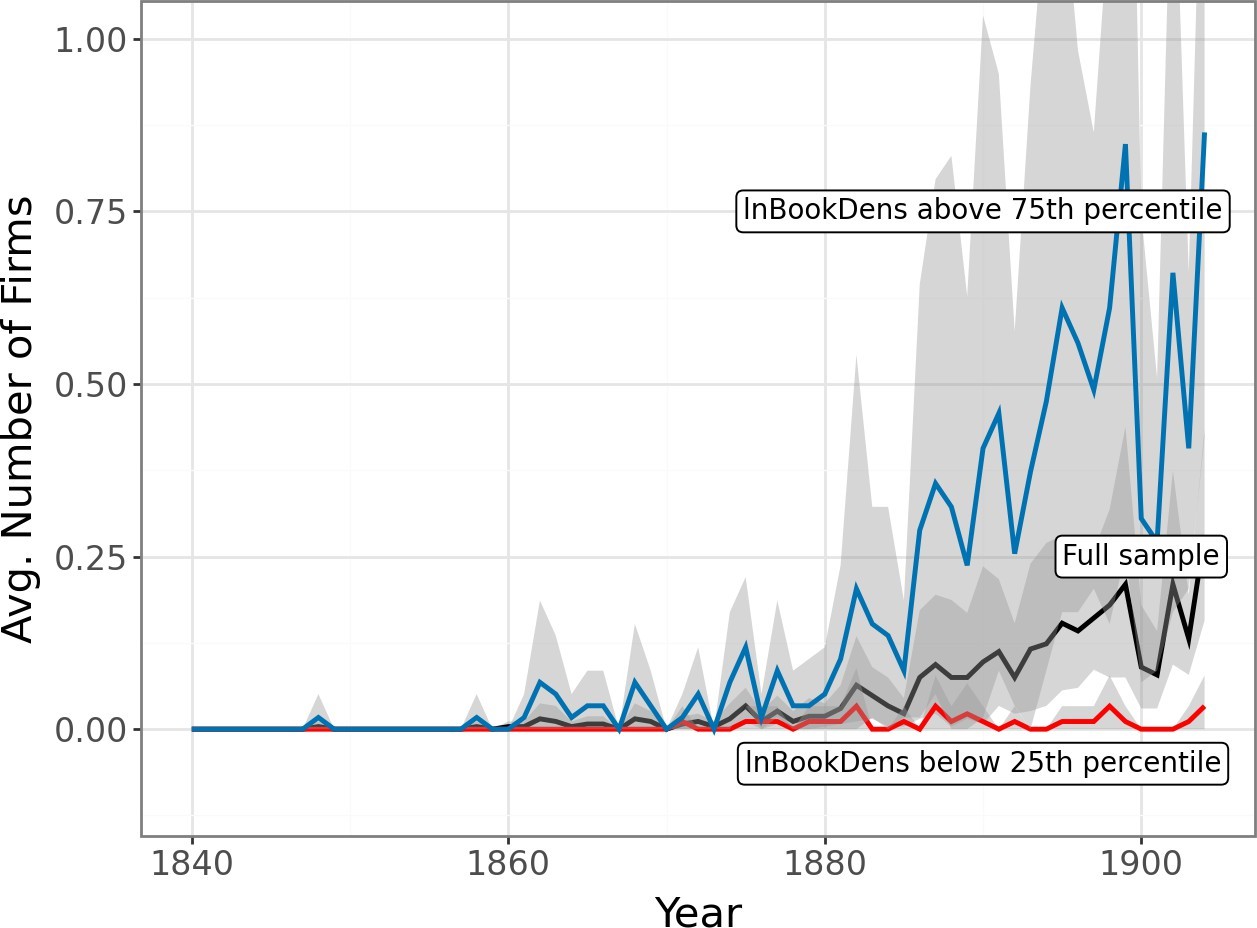
Firm-creation trends for the full sample and for prefectures above the 75th and below the 25th percentiles of log book density. The vertical axis shows the average number of new firms per year. The same pattern appears in the raw data. Figure 2 compares firm entry between prefectures in the top and bottom quartiles of book density. Before 1880, the two groups tracked each other; as ports multiplied, high-book prefectures pulled ahead. Scholarly human capital mattered in the aggregate, but not which literati supplied the margin.
Decomposing upper-tail human capital
We dissect this aggregate effect by examining book authors’ examination backgrounds, distinguishing Jìnshì degree holders from authors with lower or no exam titles. We categorize books accordingly and combine these bibliometric measures with administrative data—Shēngyuán quotas and Jìnshì rolls—to map human capital from the examination elite down to those outside the formal hierarchy. Table 1 summarizes the four measures and the literati strata each captures.
Table 1. Kējǔ Population and Measures

Note. This table categorizes intellectuals from historical China into three groups and identifies which of these are captured by the four human capital measures used in this research.
Table 2 lays out, in one place, how we peel apart the aggregate reallocation documented earlier so we can see which intellectuals moved into industrialization once treaty ports opened. The first pair of columns asks whether modern firm entry tracks the administrative stock of Jìnshì degree holders or the broader bibliometric footprint of regional scholarship: once both are included, the positive response to opening is carried by book-based human capital rather than by the density of top exam graduates on the rolls, which is at best orthogonal and, if anything, pulls in the opposite direction. The next pair of columns sharpens that contrast by splitting knowledge production at the author level—books and authors tied to Jìnshì versus all other writers—and the pattern is stark: the post-port surge in firm creation lines up with intellectuals who lacked the highest examination titles, whereas the Jìnshì-linked interactions are negative and, for author intensity, statistically distinguishable from zero. The final block nests this split alongside the Shēngyuán quota and related controls in the same spirit as the overlap mapping in Table 1: after adjusting for Jìnshì density—or for the density of books authored by Jìnshì holders—variation in quota density chiefly isolates individuals with formal titles from Shēngyuán through Jǔrén, whereas jointly controlling for both the top exam stratum and that Shēngyuán–Jǔrén layer allows books authored by non-Jìnshì writers to proxy more specifically for intellectuals situated below Shēngyuán, that is, those without any formal examination title. Even with that finer disentanglement, the industrial margin remains anchored in non-Jìnshì book producers rather than in the formal examination infrastructure alone.
Table 2. Combined regressions: Jìnshì books, author splits, and quota density
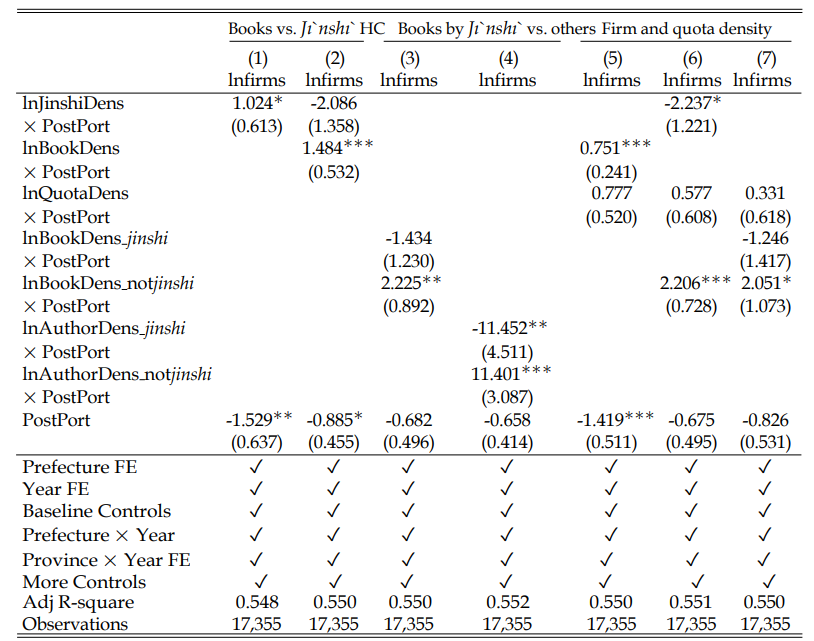
Note. Columns (1)–(2) reproduce columns (4)–(5) of Table 5 (Books vs. Jı`nshı` -related human capital). Columns (3)–(4) reproduce columns (1)–(2) of Table 6 (Books by Jı`nshı` vs. books by others; column (4) uses author-density measures). Columns (5)–(7) reproduce columns (4)–(6) of Table 8 (Firm and quota density). Standard errors in parentheses are clustered at the prefecture level. ∗ p < 0.10, ∗∗ p < 0.05, ∗∗∗ p < 0.01.
Read sequentially, the table serves our decomposition purpose: it shows that, during the final decades of the Kējǔ before its abolition in 1905, the “awakening” of latent upper-tail human capital was not an undifferentiated elite phenomenon but a reallocation of energy from the vast stratum of educated men with low or no Kējǔ achievement—failed candidates, lower-degree holders, and uncredentialed literati who nonetheless wrote and circulated knowledge—into the founding of modern enterprises, while the cohort most rewarded by the examination system contributed little of the marginal entrepreneurship we observe. Whether Jìnshì degree-holders eventually joined industrialization at scale is another story, one that unfolded only after 1905 with the examination’s abolition, as documented by Bai (2019).
Archival biographies point the same way. Of the 197 founders in our firm sample, 76 have usable life histories; where memoirs, local gazetteers, and genealogical sketches survive, they often describe men who trained in the classical curriculum yet failed to secure top degrees or regular office, then turned to trade, contracting, and “Western affairs” as treaty-port opportunities widened. One such voice:
吾祖吾父以科第起家, 吾少壮时锐欲继绳, 而卒屡踬于秋驾; 家有治谱, 常以理繁治剧自许, 而未尝假乎一州一邑为亲民之官; 保使才, 办洋务, 日与友邦人士相周旋, 而足迹未履欧美一步。 此生平三憾事也! (My ancestors made their names in Imperial Examination, and in my youth, I aspired to do the same. However, I failed in all my attempts. Despite my family’s reputation for producing competent officials, I never held a governing position. I engaged in business and industrialization projects, interacting with foreign friends. Yet, I never set foot in any Western country. These are the three regrets of my life.)
— Sheng, Xuanhuai (1916)
The cost of stability and predictability
Overall, before 1905, exposure to Western influence primarily mobilized intellectuals at the lower end of—or outside—the examination system into industrial activity, while the system continued to channel its highest achievers into bureaucratic careers. Meritocratic institutions that prize stability and predictability can be slow to release talent when new sectors appear—a misallocation cost especially salient in periods of rapid change, with parallels drawn today to high-stakes university entrance exams (Bai et al. 2024; Jia et al. 2025).
(Li Duan, School of Economics, Shanghai University of Finance and Economics, duanli@sufe.edu.cn, 777 Guoding Rd., Shanghai, 200433, P. R. China; Xiaoming Zhang, Department of Sociology, Zhejiang University, zhang.xiaoming@zju.edu.cn; Room 905, Building A, West District Creative Building, No. 866 Yuhangtang Road, Hangzhou, P.R. China.)
References
Acemoglu, Daron. 1995. “Reward Structures and the Allocation of Talent.” European Economic Review 39 (1): 17–33. https://doi.org/10.1016/0014-2921(94)00014-Q.
Aneja, Abhay, and Guo Xu. 2024. “Strengthening State Capacity: Civil Service Reform and Public Sector Performance during the Gilded Age.” American Economic Review 114 (8): 2352–87. https://doi.org/10.1257/aer.20230019.
Bai, Chong-En, Ruixue Jia, Hongbin Li, and Xin Wang. 2025. “Entrepreneurial Reluctance: Talent and Firm Creation in China.” Economic Journal 135 (667): 964–81. https://doi.org/10.1093/ej/ueae094.
Bai, Ying. 2019. “Farewell to Confucianism: The Modernizing Effect of Dismantling China’s Imperial Examination System.” Journal of Development Economics 141: 102382. https://doi.org/10.1016/j.jdeveco.2019.102382.
Besley, Timothy, Robin Burgess, Adnan Khan, and Guo Xu. 2022. “Bureaucracy and Development.” Annual Review of Economics 14: 397–424. https://doi.org/10.1146/annurev-economics-080521-011950.
Callaway, Brantly, and Pedro H. C. Sant’Anna. 2021. “Difference-in-Differences with Multiple Time Periods.” Journal of Econometrics 225: 200–230. https://doi.org/10.1016/j.jeconom.2020.12.001.
Elman, Benjamin A. 1991. “Political, Social, and Cultural Reproduction via Civil Service Examinations in Late Imperial China.” Journal of Asian Studies 50 (1): 7–28. https://doi.org/10.2307/2057472.
Geromichalos, Athanasios, and Ioannis Kospentaris. 2022. “The Unintended Consequences of Meritocratic Government Hiring.” European Economic Review 144: 104093. https://doi.org/10.1016/j.euroecorev.2022.104093.
Jia, Ruixue, Hongbin Li, and Claire Cousineau. 2025. The Highest Exam: How the Gaokao Shapes China. Harvard University Press.
Moreira, Diana, and Santiago Pérez. 2024. “Civil Service Exams and Organizational Performance: Evidence from the Pendleton Act.” American Economic Journal: Applied Economics 16 (3): 250–91. https://doi.org/10.1257/app.20220284.
Murphy, Kevin M., Andrei Shleifer, and Robert W. Vishny. 1991. “The Allocation of Talent: Implications for Growth.” Quarterly Journal of Economics 106 (2): 503–30. https://doi.org/10.2307/2937945.
Sheng, Chongyin. 1916. Sheng Xuanhuai Xingshu (a brief biography of Xuanhuai Sheng). Shanghai People’s Press. Reprinted in 1961.

Latest
Most Popular
- VoxChina Covid-19 Forum (Second Edition): China’s Post-Lockdown Economic Recovery VoxChina, Apr 18, 2020
- China’s Great Housing Boom Kaiji Chen, Yi Wen, Oct 11, 2017
- China’s Joint Venture Policy and the International Transfer of Technology Kun Jiang, Wolfgang Keller, Larry D. Qiu, William Ridley, Feb 06, 2019
- Wealth Redistribution in the Chinese Stock Market: the Role of Bubbles and Crashes Li An, Jiangze Bian, Dong Lou, Donghui Shi, Jul 01, 2020
- The Dark Side of the Chinese Fiscal Stimulus: Evidence from Local Government Debt Yi Huang, Marco Pagano, Ugo Panizza, Jun 28, 2017
- Daily Price Limits and the Magnet Effect Ting Chen, Zhenyu Gao, Jibao He, Wenxi Jiang, Wei Xiong, Oct 25, 2017
- Evaluating Risk across Chinese Housing Markets Yongheng Deng, Joseph Gyourko, Jing Wu, Aug 02, 2017
- What Is Special about China’s Housing Boom? Edward L. Glaeser, Wei Huang, Yueran Ma, Andrei Shleifer, Jun 20, 2017
- Privatization and Productivity in China Yuyu Chen, Mitsuru Igami, Masayuki Sawada, Mo Xiao, Jan 31, 2018
- How did China Move Up the Global Value Chains? Hiau Looi Kee, Heiwai Tang, Aug 30, 2017