
A Bridge on Economic Issues between China and the World



 Facebook
 Twitter
 Instagram
 WeChat
 Email
Target-Based Governance and Bureaucratic Incentives in China’s Air Pollution Control
How do agents allocate efforts when some tasks are governed by continuous rewards while others impose minimum standards? This question is central to many organizations and it is especially salient in public governance. Studying China’s air-pollution controls, where local officials face binding air quality index targets alongside growth incentives, we show that local officials improve air quality after failure becomes unavoidable but relax once targets are secured early. The findings reveal how different target forms, not only competing objectives, shape bureaucratic efforts under multitasking and inform performance-target design.

Governments, firms, and other large institutions often ask agents to deliver on multiple dimensions at once: growth and risk control, output and quality, efficiency and safety, development and environmental protection. In practice, these objectives are often governed by different types of targets. Some targets reward continuous improvement, while others define minimum standards that must be met. This combination is common, but it creates a fundamental incentive-design problem: how do agents allocate efforts when one objective offers marginal rewards and another imposes threshold-based punishment?
A classic insight from multitasking theory is that performance incentives can distort effort allocation when agents are responsible for multiple tasks (e.g., Holmstrom and Milgrom 1991, Baker 1992, Hart et al. 1997). Much of this logic becomes especially relevant when different tasks are not only measured separately, but also governed by different incentive forms. The key question is therefore not simply whether targets induce effort, but how agents respond when continuous incentives and minimum-standard incentives coexist within the same evaluation system.
In Cao et al. (2026), we study this question in the context of China’s air-pollution control system. Our findings show that local officials respond sharply when the status of a minimum-standard environmental target changes. Importantly, failure does not necessarily lead to giving up, and success does not necessarily lead to continued effort. Instead, bureaucrats adjust environmental enforcement in ways that reflect the broader incentive trade-offs embedded in China’s hybrid target system.
Hybrid incentive contracts in Chinese government
China provides a useful setting to study this problem because local officials operate under a target-based evaluation system with explicitly different incentive forms. Since the Eleventh Five-Year Plan, China has distinguished between anticipatory targets and obligatory targets. Anticipatory targets, such as economic growth and fiscal revenue, serve as guiding objectives. They are not binding in a narrow legal sense, but they remain closely related to local officials’ political performance and career prospects. In incentive terms, they are closer to “the higher, the better.”
Obligatory targets work differently. These targets, which cover areas such as environmental protection, emission reduction, and public safety, define minimum requirements that local governments are expected to meet. Failure can trigger administrative pressure, public criticism, or adverse career consequences. At the same time, over-fulfilling an obligatory target usually brings limited additional reward. In incentive terms, these targets are closer to “hitting the threshold.”
This combination creates a hybrid target system. Local officials are encouraged to continuously improve on some dimensions, and are required to satisfy minimum standards on others. The system is designed to balance development with bottom-line constraints. But it also creates a central incentive problem. Local officials must decide how to allocate limited attention and regulatory capacity between tasks that reward continuous improvement and those that mainly punish failure.
China’s air-pollution control campaign and air quality index targets
Air-pollution control became one of China’s most salient obligatory targets after severe haze episodes drew broad public and policy attention. A key measure in this campaign is the air quality index (AQI), which summarizes daily air pollution into a single measure. Days with AQI no greater than 100 are classified as days with good or moderate air quality. Local governments were assigned annual targets for the number or share of such days.
Figure 1. How air quality index (AQI) targets create two completion statuses
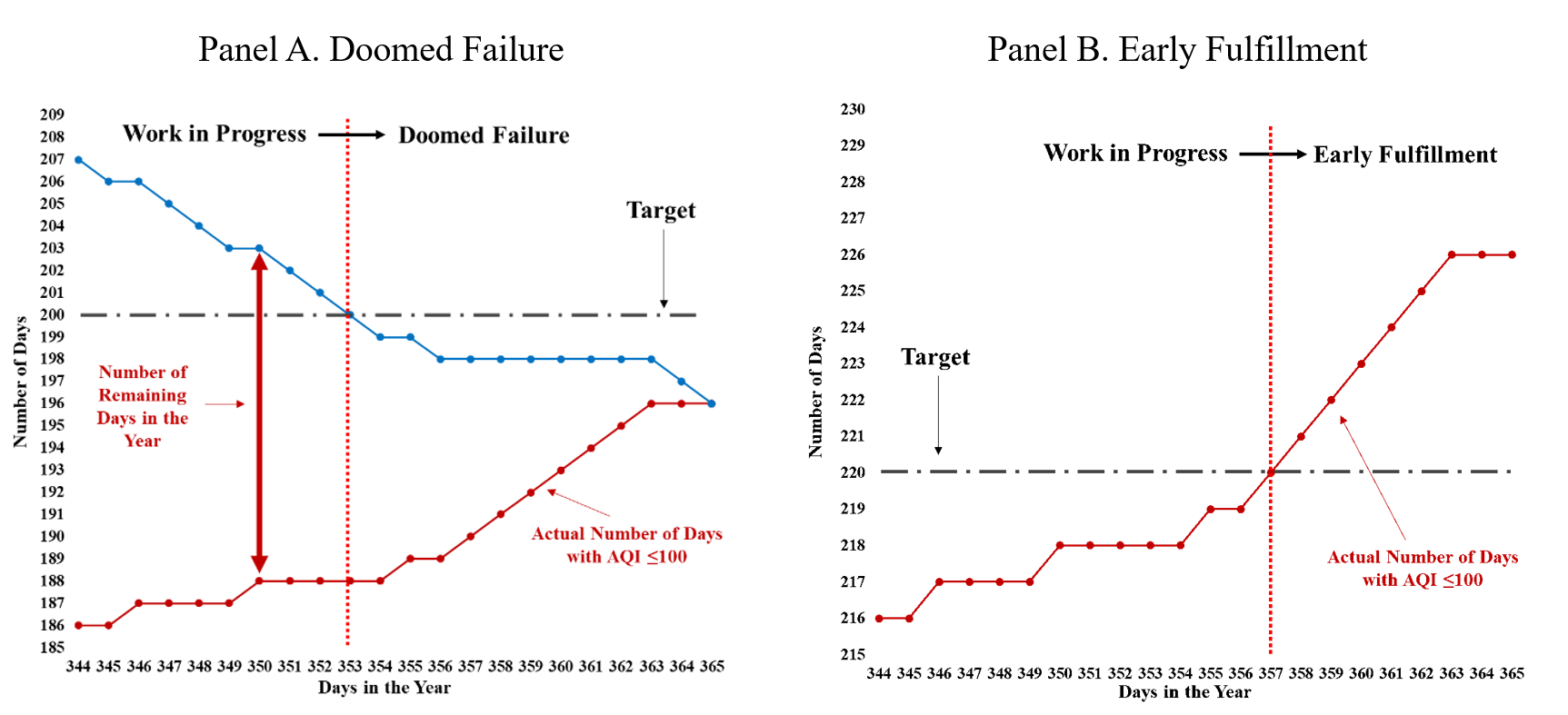
This target rule generates sharp changes in incentives within the year. Because AQI readings are publicly released and the number of days in a calendar year is fixed (either 365 or 366), local officials can track their target-completion status on a daily basis. As the year unfolds, a city may enter one of two distinct statuses. The first is doomed failure: even if every remaining day has AQI no greater than 100, the city can no longer meet its annual target. The second is early fulfillment: even if every remaining day has AQI above 100, the city has already secured the target.
These two statuses change the marginal value of environmental effort. After doomed failure, officials can no longer avoid missing the target, but they may still reduce the severity of failure. After early fulfillment, the obligatory target has been met, and additional environmental effort brings little extra return. The AQI target therefore provides a simple way to observe how bureaucrats respond when the incentive value of environmental regulation changes sharply.
Officials respond asymmetrically to target status
Using daily AQI data for Chinese cities from 2015 to 2019, we compare air quality just before and after the two target-status dates illustrated in Figure 1. These dates provide sharp changes in incentives. Before doomed failure, officials may still hope to meet the annual target. After doomed failure, meeting the target is no longer possible. Before early fulfillment, officials still need additional good-air days. After early fulfillment, the target has already been secured.
The results reveal two asymmetric responses. When a city becomes doomed to fail, air quality improves. This finding is not the most intuitive one: If the target can no longer be met, one might expect officials to give up. Instead, they appear to exert compensatory effort. Although they cannot avoid missing the target, they can still reduce the severity of failure and demonstrate remedial action. In an obligatory-target system, failure is not simply a zero-one outcome. A less severe failure may still matter for accountability.
The opposite pattern appears after early fulfillment. Once a city has secured its annual AQI target, air quality deteriorates. This response is easier to understand under a hybrid target system. Additional environmental effort brings little extra return after the obligatory target has been met, while other objectives, such as economic growth or industrial activity, continue to offer marginal rewards. Officials therefore have incentives to reallocate attention and regulatory capacity away from air-pollution control.
Why do officials respond this way?
The key force behind these responses is uncertainty. At the beginning of the year, officials do not know whether their city will eventually meet the AQI target. Weather conditions, industrial activity, regional pollution transport, and regulatory effort all affect the number of good-air days. Officials therefore update their expectations as the year unfolds.
Once the target status becomes clear, the incentive problem changes. After doomed failure, the question is no longer whether the city can meet the target, but how costly the failure will be. Officials may still reduce pollution to limit the severity of noncompliance and signal remedial effort. This logic explains why failure can induce additional environmental effort rather than simple abandonment.
After early fulfillment, the opposite logic applies. The binding environmental target has already been secured, so further improvement brings limited additional return. In a hybrid target system, officials may then shift attention toward objectives that still generate marginal rewards, especially economic growth and industrial activity. The deterioration in air quality after early fulfillment is therefore not simply shirking; it reflects effort reallocation across competing targets.
The data are consistent with this interpretation. The discontinuous responses are stronger when officials faced greater uncertainty before the threshold date, suggesting that the change in target status conveys meaningful new information. The responses also vary with local bureaucrats’ political incentives and, more importantly, with growth pressure. When local officials face less pressure to deliver growth, they exert stronger compensatory effort after doomed failure and show less relaxation after early fulfillment. When growth pressure is stronger, they are more likely to redirect attention toward economic activity once the AQI target has been secured, leading to a sharper deterioration in air quality. The same AQI target can therefore generate different enforcement responses depending on the competing value of growth-oriented effort.
Implications for performance-target design
Our study highlights the importance of viewing government performance targets as part of a broader incentive system. Obligatory targets are useful because they define enforceable bottom lines in areas such as environmental protection, emission reduction, and public safety. Yet their effects depend on how they interact with other objectives, especially high-powered incentives for economic growth. In a multitasking environment, the key design issue is not only whether a target is strict, but how its marginal incentives change as the target outcome becomes clearer over time.
The broader lesson is therefore not to abandon obligatory targets, but to refine them. A well-designed system should preserve the disciplinary role of minimum standards while reducing incentives for threshold-based effort allocation. Future research on hybrid incentive contracts in richer institutional settings can further clarify when minimum targets complement high-powered incentives and when they create unintended distortions.
References
Baker, George P. 1992. “Incentive Contracts and Performance Measurement.” Journal of Political Economy 100 (3): 598–614. https://www.jstor.org/stable/2138733.
Cao, Guangyu, Xi Weng, Mingwei Xu, and Li-An Zhou. 2026. “How Do Bureaucrats Respond to Hybrid Incentive Contract? Evidence from China’s Air Pollution Controls.” Journal of Public Economics 259: 105664. https://doi.org/10.1016/j.jpubeco.2026.105664.
Hart, Oliver, Andrei Shleifer, and Robert W. Vishny. 1997. “The Proper Scope of Government: Theory and an Application to Prisons.” Quarterly Journal of Economics 112 (4): 1127–61. https://doi.org/10.1162/003355300555448.
Holmstrom, Bengt, and Paul Milgrom. 1991. “Multitask Principal–Agent Analyses: Incentive Contracts, Asset Ownership, and Job Design.” Journal of Law, Economics, and Organization 7: 24–52. https://doi.org/10.1093/jleo/7.special_issue.24.

Latest
Most Popular
- VoxChina Covid-19 Forum (Second Edition): China’s Post-Lockdown Economic Recovery VoxChina, Apr 18, 2020
- China’s Great Housing Boom Kaiji Chen, Yi Wen, Oct 11, 2017
- China’s Joint Venture Policy and the International Transfer of Technology Kun Jiang, Wolfgang Keller, Larry D. Qiu, William Ridley, Feb 06, 2019
- The Dark Side of the Chinese Fiscal Stimulus: Evidence from Local Government Debt Yi Huang, Marco Pagano, Ugo Panizza, Jun 28, 2017
- Wealth Redistribution in the Chinese Stock Market: the Role of Bubbles and Crashes Li An, Jiangze Bian, Dong Lou, Donghui Shi, Jul 01, 2020
- Evaluating Risk across Chinese Housing Markets Yongheng Deng, Joseph Gyourko, Jing Wu, Aug 02, 2017
- Daily Price Limits and the Magnet Effect Ting Chen, Zhenyu Gao, Jibao He, Wenxi Jiang, Wei Xiong, Oct 25, 2017
- What Is Special about China’s Housing Boom? Edward L. Glaeser, Wei Huang, Yueran Ma, Andrei Shleifer, Jun 20, 2017
- Privatization and Productivity in China Yuyu Chen, Mitsuru Igami, Masayuki Sawada, Mo Xiao, Jan 31, 2018
- How did China Move Up the Global Value Chains? Hiau Looi Kee, Heiwai Tang, Aug 30, 2017