
A Bridge on Economic Issues between China and the World



 Facebook
  Twitter
  Instagram
 WeChat
  Email
Email Public-Asset IPO for Sharing Growth Across Generations
How can fast-growing economies share economic gains with cohorts whose working lives end before wages catch up? We show that subsidized access of appreciating public assets can give incumbent households an early stake in future growth. A quantitative model of China’s housing privatization shows that buyers benefit from both purchase discounts and subsequent capital gains. Compared with a pension delivering the same average welfare gain, this policy leaves later cohorts better off and adjusts automatically when growth slows.

Periods of rapid growth create an intergenerational challenge. Workers who enter the labor market after productivity and wages growth have risen spend most of their careers in a richer economy. Those approaching retirement when growth takes off experience only a small share of the increase in lifetime earnings. What policies can facilitate the sharing of economic gains with these earlier generations without imposing excessive burdens on those who follow?
Fiscal policy offers one answer. Taxes, public debt, and social insurance can transfer resources from later workers to earlier generations. Song et al. (2015), for example, study how pensions can share the gains from rapid growth. Pension benefits, once increased, are politically hard to adjust downward, thus they create a continuing claim on future tax revenue that will become harder to finance as growth slows and the population ages.
Redistribution also occurs through asset prices. Glover et al. (2020) show how macroeconomic shocks redistribute welfare across age groups as house and other asset prices change. Using administrative data, Fagereng et al. (2025) measure how such changes affect households with different portfolios. These studies explain why asset-price movements create winners and losers across cohorts, but generally take the initial distribution of ownership as given. This leaves an important policy question: Can governments redistribute resources by influencing who owns appreciating assets before economic growth is capitalized into their prices?
Experiences in Singapore, South Korea, and China show how governments have done so. In each case, selected households were allowed to buy public or regulated homes below market value before rising incomes and housing demand were fully reflected in prices. The discount provided an immediate transfer, while early ownership gave buyers a claim on future appreciation. These cases turn the asset-price channel identified in the literature into a policy choice. They motivate the question at the center of our paper: What role can subsidized access to appreciating public assets play in intergenerational redistribution during periods of rapid growth?
We (Chen et al. 2026) answer this question in two steps. A simple framework shows how a government that owns appreciating assets but has limited cash can give incumbent households an early claim on future growth by offering them a public-asset initial public offering (IPO) on preferential terms. We then develop a quantitative life-cycle model in which households differ by age and skill; choose whether to rent or own and how much housing to hold, borrow, or trade up; and leave wealth to their children. The model has two key ingredients. First, it distinguishes smaller public units from larger commercial homes. Together with borrowing constraints, this distinction generates life-cycle choices over renting, ownership, housing size, and trade-ups. Second, access to subsidized public housing varies across cohorts. As income growth is capitalized into housing values, these policies determine which generations receive the resulting capital gains and how welfare is redistributed across cohorts.
How a public-asset IPO shares future growth?
Asset-based redistribution operates through two channels: the purchase discount provides an immediate benefit, and early ownership determines who receives future appreciation. As incomes rise, households demand more housing, so an asset acquired during the early stage of development can become much more valuable later.
Housing creates important feedback. Owners can sell a subsidized unit and use the proceeds to buy a larger home. Their trade-up demand can contribute to increasing housing prices, changing the capital gains received by all owners. Policy therefore affects both the allocation of appreciating assets and the size of the gains those assets generate.
The mechanism also shapes how transfers reach later generations. Housing wealth can pass to the next generation through gifts and bequests, although later homebuyers may also face higher prices. Because capital gains depend on realized income growth, housing supply, and market demand, the transfer contains an automatic stabilizer: Weaker growth reduces appreciation and the size of the transfer. Pension promises do not adjust in the same way. Asset ownership can therefore carry redistribution beyond the original sale without creating the same continuing claim on future tax revenue.
Quantifying asset-based redistribution in China
We calibrate the model to China’s urban housing privatization. The 1994 reform allowed eligible tenants to buy public homes allocated by their employers or work units at subsidized prices. In our calibration, discounts rise with age, from 22.5% for households aged 21 to 25 to 58.5% for those older than 60. Reforms in 1998 ended new work-unit housing allocations and introduced residential mortgages with a 30% down payment, making it easier for owners to sell their units and move into commercial housing.
The results show that early ownership substantially changed subsequent housing demand. Households selling privatized units to buy commercial homes account for about 68% of commercial housing demand in 2000 and 54% in 2005. Selling the original unit helps finance the down payment, allowing these households to trade up with less debt. The capital gains are also large: Depending on age and the year of sale, they amount to roughly 4.5 to 7 times the contemporaneous average annual wage.
These choices also affect the path of housing prices. With the purchase subsidy, prices are initially lower because transferring ownership of an occupied unit does not immediately create demand for additional housing. Later, early owners accumulate wealth and some trade up, increasing demand for commercial homes. In the calibrated model, removing the subsidy lowers average annual house-price growth between 2000 and 2015 from 7.3% to 5.4% (Figure 1).
Figure 1. Housing prices with and without public housing purchase subsidies
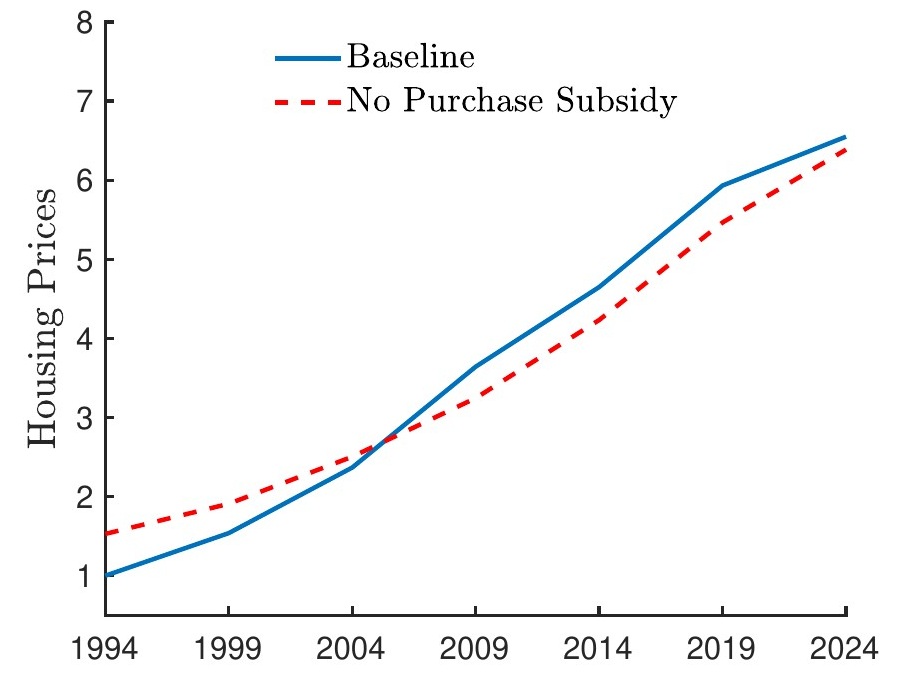
Note: The baseline includes the age-related public housing purchase subsidies. The comparison removes the discounts but retains eligible households' option to purchase at market prices. The baseline housing price in 1994 is normalized to one. Source: Chen, Fang, and Tang (2026).
Welfare gains also vary by age across incumbent cohorts. Younger incumbent households benefit from earlier ownership and have more time to trade up. Older households trade up less, but appreciation is especially valuable relative to their limited remaining labor income. They can sell the home later or preserve its value for their children.
The automatic-stabilizer advantage over pensions
To isolate this advantage, we construct a counterfactual economy that replaces the housing subsidy with a pension reform delivering the same average welfare gain to the incumbent generations. Matching that gain requires raising the pension replacement rate from 60% to 82% and the social security contribution rate from 23.1% to 34.0%. The pension alternative requires a lower general labor-income tax because it eliminates the housing subsidy, but its higher payroll contribution continues to burden later workers.
In the calibrated model, cohorts entering the economy after privatization are better off under the asset-based policy than under the pension alternative, for both skill groups. As shown in Figure 2, the advantage is largest for cohorts entering in the 1990s and early 2000s: They buy when housing remains relatively inexpensive and benefit from later appreciation. Some also receive transfers and bequests supported by the initial owners’ housing wealth. The advantage declines for later cohorts as the two economies converge.
Figure 2. Welfare of later cohorts under asset-based and pension-based redistribution
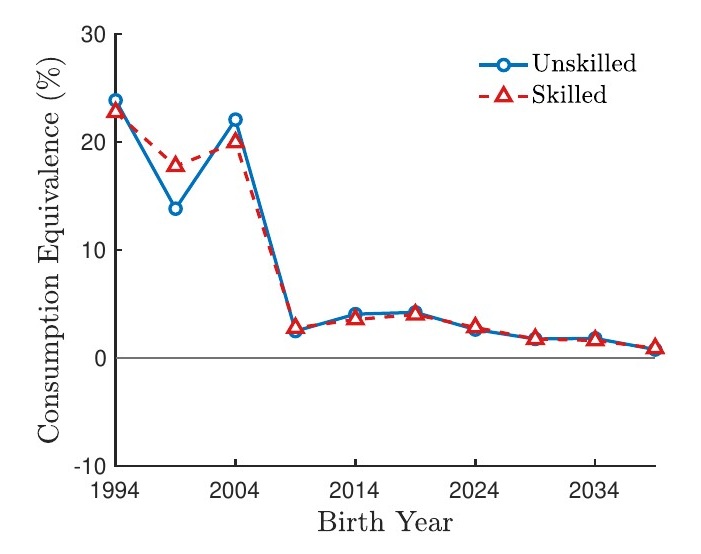
Note: Positive values indicate that a cohort is better off under the baseline housing policy than under the pension alternative. Cohorts are indexed by the year in which they enter the economy at age 21. Source: Chen, Fang, and Tang (2026).
The slowdown experiment makes the automatic adjustment clear. When an unexpected slowdown began in 2015 and tax rates remained fixed, cumulative government deficits equaled 24.9% of tax revenue under the asset-based policy, compared with 54.2% under the pension alternative. Weaker growth reduced housing appreciation and thereby scaled back part of the asset-based transfer. The higher pension replacement rate did not fall automatically; it continued to claim revenue from a smaller payroll base.
Designing asset-based redistribution
The mechanism need not take the form of a direct sale of state-owned homes. Singapore combined subsidized public housing with a gradually liberalized resale market, allowing early ownership to become household wealth (Bardhan et al. 2003, Phang and Helble 2016). South Korea used price ceilings and rationed access to newly constructed homes; successful buyers later realized capital gains as controls were relaxed and markets developed (Kim and Park 2016). The common element was the preferential allocation of valuable housing before growth was fully reflected in asset prices.
Policy design determines who receives those gains. Eligibility rules, purchase prices, and access to credit shape whether the subsidy reaches households with low lifetime income or mainly those already able to buy. Resale rights allow appreciation to finance consumption or a move to a better home, but loose resale rules can also encourage speculation.
Redistribution across generations can also widen inequality within a generation. Similar discounts produce different windfalls across locations when income growth, migration, land supply, and housing demand differ. Later entrants may face higher acquisition costs, especially where housing supply is constrained. Transparent eligibility, valuation, and resale rules are therefore central to the policy, not administrative details.
Implications for China today
China now faces almost the reverse of the intergenerational problem that motivated the 1990s reform. Many households that obtained subsidized housing early in the transition accumulated substantial capital gains. Younger households are entering the labor market after the high-growth era, facing slower wage growth, less secure employment, and weaker expectations of housing appreciation. Current macroeconomic data underscore this demand problem: In the first eight months of 2026, industrial value added grew by 5.3%, while retail sales of consumer goods rose by only 1.1% and the area of new housing sold fell by 12.1% (National Bureau of Statistics of China 2026). The divide is therefore not only between homeowners and non-homeowners. It is also between cohorts whose wealth was lifted by past growth and those whose housing demand and consumption depend mainly on current labor income.
The broader lesson is that asset-based redistribution should be evaluated over the full development cycle. During rapid growth, a public-asset IPO can give earlier generations a stake in future appreciation. After growth slows, the same framework asks whether those accumulated gains have become a barrier to the next generation’s household formation and consumption. Recycling a carefully defined share of past windfalls toward younger households would not require reviving a growth strategy driven by property investment and rising house prices. Instead, it would redirect some of the housing wealth accumulated during that era toward household purchasing power and domestic demand, without creating new, open-ended fiscal claims on future workers’ earnings. In this sense, intergenerational redistribution can support China’s macroeconomic rebalancing from asset appreciation and investment toward household purchasing power and consumption.
(Kaiji Chen, Emory University; Hanming Fang, University of Pennsylvania and National Bureau of Economic Research; Yang Tang, Nanyang Technological University)
References
Bardhan, Ashok Deo, Rajarshi Datta, Robert H. Edelstein, and Lum Sau Kim. 2003. “A Tale of Two Sectors: Upward Mobility and the Private Housing Market in Singapore.” Journal of Housing Economics 12 (2): 83–105. https://doi.org/10.1016/S1051-1377(03)00016-0.
Chen, Kaiji, Hanming Fang, and Yang Tang. 2026. “Asset Privatization as Intergenerational Redistribution.” National Bureau of Economic Research Working Paper No. 35754. https://www.nber.org/papers/w35754.
Fagereng, Andreas, Matthieu Gomez, Émilien Gouin-Bonenfant, Martin Holm, Benjamin Moll, and Gisle Natvik. 2025. “Asset-Price Redistribution.” Journal of Political Economy 133 (11): 3494–3549. https://doi.org/10.1086/736769.
Glover, Andrew, Jonathan Heathcote, Dirk Krueger, and José-Victor Ríos-Rull. 2020. “Intergenerational Redistribution in the Great Recession.” Journal of Political Economy 128: 3730–78. https://doi.org/10.1086/708820.
Kim, Kyung-Hwan, and Miseon Park. 2016. “Housing Policy in the Republic of Korea.” Asian Development Bank Institute Working Paper 570. https://www.adb.org/publications/housing-policy-republic-korea.
National Bureau of Statistics of China. 2026. National Economic Performance in August 2026. September 15.
Phang, Sock-Yong, and Matthias Helble. 2016. “Housing Policies in Singapore.” Asian Development Bank Institute Working Paper 559. https://www.adb.org/publications/housing-policies-singapore.
Song, Zheng, Kjetil Storesletten, Yikai Wang, and Fabrizio Zilibotti. 2015. “Sharing High Growth Across Generations: Pensions and Demographic Transition in China.” American Economic Journal: Macroeconomics 7: 1–39. https://doi.org/10.1257/mac.20130322.

Latest
Most Popular
- VoxChina Covid-19 Forum (Second Edition): China’s Post-Lockdown Economic Recovery VoxChina, Apr 18, 2020
- China’s Great Housing Boom Kaiji Chen, Yi Wen, Oct 11, 2017
- China’s Joint Venture Policy and the International Transfer of Technology Kun Jiang, Wolfgang Keller, Larry D. Qiu, William Ridley, Feb 06, 2019
- The Dark Side of the Chinese Fiscal Stimulus: Evidence from Local Government Debt Yi Huang, Marco Pagano, Ugo Panizza, Jun 28, 2017
- Wealth Redistribution in the Chinese Stock Market: the Role of Bubbles and Crashes Li An, Jiangze Bian, Dong Lou, Donghui Shi, Jul 01, 2020
- Evaluating Risk across Chinese Housing Markets Yongheng Deng, Joseph Gyourko, Jing Wu, Aug 02, 2017
- Daily Price Limits and the Magnet Effect Ting Chen, Zhenyu Gao, Jibao He, Wenxi Jiang, Wei Xiong, Oct 25, 2017
- What Is Special about China’s Housing Boom? Edward L. Glaeser, Wei Huang, Yueran Ma, Andrei Shleifer, Jun 20, 2017
- Privatization and Productivity in China Yuyu Chen, Mitsuru Igami, Masayuki Sawada, Mo Xiao, Jan 31, 2018
- How did China Move Up the Global Value Chains? Hiau Looi Kee, Heiwai Tang, Aug 30, 2017