
A Bridge on Economic Issues between China and the World



 Facebook
  Twitter
  Instagram
 WeChat
  Email
Email How China’s Exchange Rate Policy Shaped the China Shock
The usual story of the China shock focuses on cheap Chinese labor, rapid productivity growth, and the loss of US manufacturing jobs. Our paper adds a missing piece: China’s exchange-rate policy. By keeping the renminbi closely tied to the dollar, China slowed the normal price adjustment that would have made its goods more expensive as its productivity rose. This made Chinese exports cheaper for longer, intensified the pressure on US manufacturing, and helped generate the bilateral trade deficit as a result of consumption smoothing. Yet the same policy raised average US welfare by lowering consumer prices, even as it imposed concentrated losses on manufacturing workers.

Debates over US-China trade often center on jobs and deficits: How much did Chinese import competition affect US manufacturing communities, and why did large trade imbalances emerge between the two countries? These questions unfolded alongside a third fact: China’s exchange rate was tightly managed against the dollar. Figure 1 brings together four familiar facts: rising Chinese import penetration in the US, declining US manufacturing employment, a persistent US bilateral trade deficit, and the renminbi tightly managed against the dollar, under an explicit peg until 2005 and a crawling band thereafter (Ilzetzki et al. 2019).
Figure 1
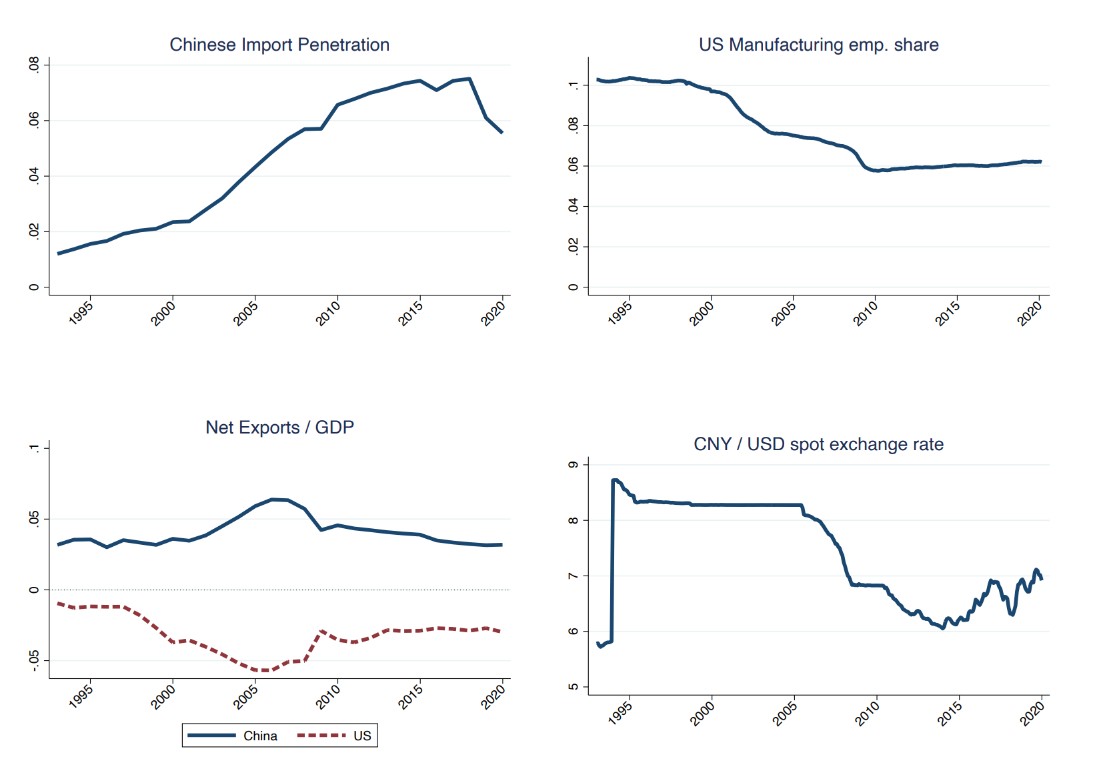
Existing research has connected some of these facts. Economists have shown that the surge in Chinese imports affected US manufacturing communities (Autor et al. 2013), and later works studied these effects in dynamic models of trade and labor markets (Caliendo et al. 2019, Rodríguez-Clare et al. 2026). There is a large literature on the trade imbalance through a "global savings glut" rooted in financial forces (Bernanke 2005, Caballero et al. 2008), though Kehoe et al. (2018) find this channel explains a small share of the manufacturing decline. The exchange rate has been a recurring concern in policy circles, but less central in quantitative accounts of the China shock.
A natural question sits in between: did China’s exchange rate regime merely accompany the China shock, or did it shape its effects? Models of the China shock typically take exchange rates as given, while open-economy macro models are often too aggregated to study sectoral employment. In our recent work (Kim et al. 2026), we bridge this gap, and find that incorporating exchange rate policy changes the picture more than one might expect.
The mechanism: Exchange rates and nominal wage rigidity
Relative prices between countries can adjust in two ways: through exchange rates, or through domestic wages and prices. Exchange rates can move quickly; wages usually move slowly. Friedman’s (1953) classic case for flexible exchange rates was that currencies can absorb shocks faster than wages and prices. China’s dollar peg limited this adjustment: as Chinese productivity rose in the 2000s, the relative price between Chinese and US goods could not adjust through the currency. The burden instead fell on wages and domestic prices. Because wages move slowly, Chinese goods remained temporarily cheaper in dollar terms than they would have been after full adjustment.
This has two effects. First, the temporary underpricing front-loads US substitution toward Chinese goods, depressing short-run US manufacturing demand and raising unemployment in affected sectors. Second, anticipating that the export boom rests on a temporarily favorable price, Chinese households save part of the windfall. Through reserve accumulation and dollar-asset purchases that maintain the exchange rate policy, this saving helps finance the US deficit. In this view, manufacturing unemployment and the trade imbalance are two sides of the same coin: suppressed relative-price adjustment.
Quantitative impact of the currency peg
To take the model to the data, we calibrate productivity, trade costs, preferences, and labor mobility costs to match observed trade flows and US sectoral labor reallocation from 2000 to 2012. The model nests two literatures: dynamic trade with input-output linkages and frictional labor mobility (Caliendo et al. 2019), and open-economy New Keynesian macro with sticky wages, consumption-savings and exchange rate determination. Joint quantitative work of this kind has been computationally infeasible; we apply sequence-space methods (Boppart et al. 2018), which make it tractable on a laptop.
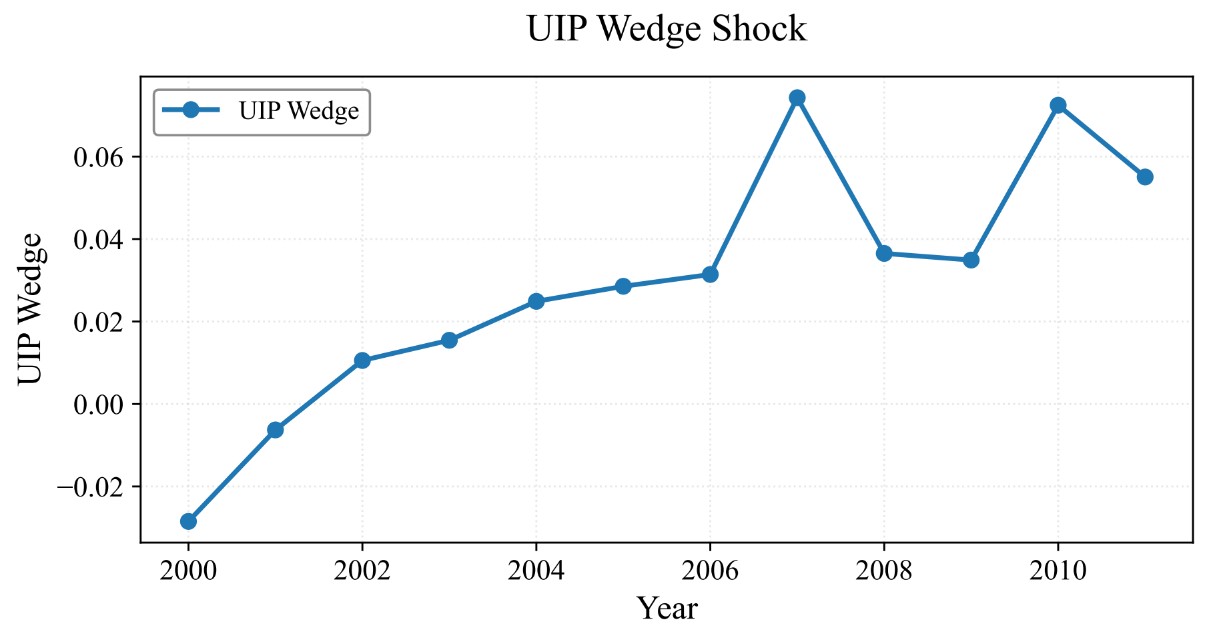
An important input is China’s exchange rate policy, which we recover from data. Standard uncovered interest rate parity (UIP) determines the exchange rate in frictionless markets; capital controls and FX intervention impede that arbitrage, so UIP fails systematically. We measure the UIP wedge as the gap between the two sides of the ex-post UIP condition, given observed US and Chinese policy rates and the realized CNY–USD exchange-rate path. Because the realized path embeds the hard peg through 2005 and the gradual appreciation thereafter, it reproduces China’s actual managed regime by construction. The recovered wedge (Figure 2) is persistently positive: Ex post, Chinese bonds earned a higher dollar return than US bonds, an excess return that frictionless arbitrage would have erased by appreciating the yuan, but which persists here as the result of intervention. Thus, the exchange-rate policy in the model is not imposed arbitrarily; it is pinned down by observed financial data.
Figure 2
Our main counterfactual keeps China’s productivity growth, trade costs, preferences, and all other fundamentals unchanged, but changes the exchange-rate regime. Instead of managing the yuan against the dollar, China follows an independent Taylor rule and allows the exchange rate to float—that is, we set the UIP wedge to zero, so the exchange rate is market-determined by the standard frictionless UIP condition. Table 1 reports the comparison of this counterfactual.
Table 1. Decomposing China Shock
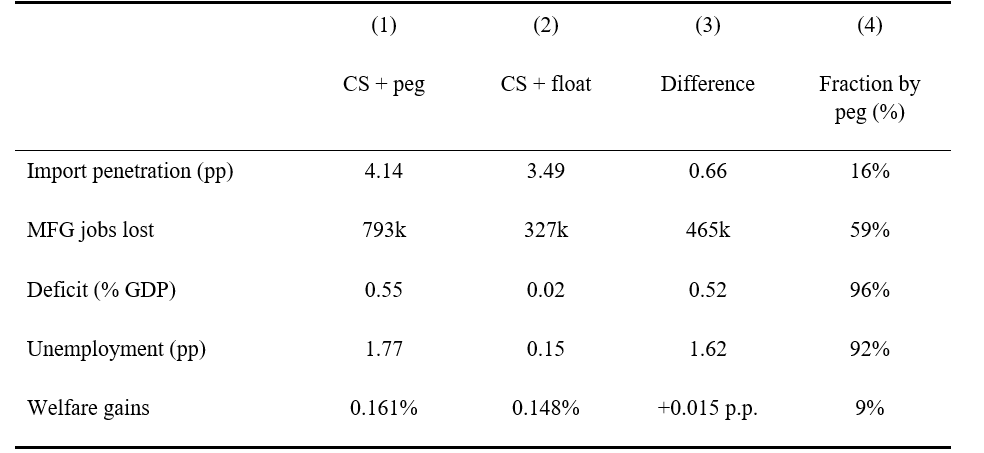
Note: All values in columns (1) and (2) denote differences relative to a no-China-shock benchmark. Import penetration is the increase between 2000–2012 (pp); MFG jobs lost is the 2012 level difference (thousands); deficit is the 2001–2012 average (% of GDP); Unemployment is the increase between 2000–2012 (pp); and welfare gains are consumption-equivalent variations (CEV).
Under a float, 59% of the decline in US manufacturing employment attributable to the China shock would not have occurred. The shock-induced US trade deficit is also almost entirely absent. Excess unemployment largely disappears as well. Comparing the realized economy to the counterfactual economy reveal that Chinese productivity growth matters, but a bulk of its effect on US manufacturing, unemployment, and the trade deficit comes from the muted exchange-rate adjustment.
This also changes the interpretation of China’s “savings glut.” We recover a residual saving shock needed to match Chinese net exports, but once the peg is accounted for, this residual explains little of the US manufacturing decline or trade deficit. Financial forces alone do not account for much of the manufacturing effect. The main transmission runs through the exchange-rate regime.
The twist: Positive vs. normative
The analysis above may seem to vindicate the policy circle view that China’s currency policy was a culprit behind outcomes that hurt the US: manufacturing job losses, unemployment in exposed sectors, and a larger bilateral deficit. But the normative conclusion is different.
In our welfare calculations, the peg made the average US household better off by modestly increasing the gains from trade with China. The reason is simple: Cheaper Chinese imports improved US terms of trade by more than involuntary unemployment reduced welfare. The costs were concentrated among workers in trade-exposed sectors, while the gains were spread across consumers. The peg therefore hurt some US workers, widened the deficit, and still raised average US welfare.
Conclusion
Our paper provides a unified account of trade, current accounts, and the exchange rate. In our model, the peg accounts for most of the China shock’s effect on US manufacturing and the bilateral deficit, even as it improves US welfare in aggregate by lowering the dollar price of imports. Symmetrically, it suppressed Chinese household consumption—a cost that China’s long-running rebalancing agenda can partly be read as an attempt to undo.
The same logic extends beyond this episode. Exchange-rate regimes shape how trade shocks are transmitted, from the postwar growth of Japan and Korea to trade imbalances within the Eurozone and current debates over tariffs and exchange rates. Why China chose the peg despite its domestic costs is a separate question. The key lesson is that exchange rates shape the labor-market and trade-balance effects of globalization.
Reference
Autor, David H., David Dorn, and Gordon H. Hanson. 2013. “The China Syndrome: Local Labor Market Effects of Import Competition in the United States.” American Economic Review 103 (6): 2121–68. https://doi.org/10.1257/aer.103.6.2121.
Bernanke, Ben. 2005. “The Global Saving Glut and the U.S. Current Account Deficit.” Sandridge Lecture, Virginia Association of Economists.
Boppart, Timo, Per Krusell, and Kurt Mitman. 2018. “Exploiting MIT Shocks in Heterogeneous-Agent Economies: The Impulse Response as a Numerical Derivative.” Journal of Economic Dynamics and Control 89: 68–92. https://doi.org/10.1016/j.jedc.2018.01.002.
Caliendo, Lorenzo, Maximiliano Dvorkin, and Fernando Parro. 2019. “Trade and Labor Market Dynamics: General Equilibrium Analysis of the China Trade Shock.” Econometrica 87 (3): 741–835. https://doi.org/10.3982/ECTA13758.
Friedman, Milton. 1953. “The Case for Flexible Exchange Rates.” In Essays in Positive Economics. Chicago: University of Chicago Press.
Ilzetzki, Ethan, Carmen M. Reinhart, and Kenneth S. Rogoff. 2019. “Exchange Arrangements Entering the 21st Century: Which Anchor Will Hold?” Quarterly Journal of Economics 134 (2): 599–646. https://doi.org/10.1093/qje/qjy033.
Kehoe, Timothy J., Kim J. Ruhl, and Joseph B. Steinberg. 2018. “Global Imbalances and Structural Change in the United States.” Journal of Political Economy 126 (2): 761–96. https://doi.org/10.1086/696279.
Kim, Bumsoo, Marc de la Barrera, and Masao Fukui. 2026. “Currency Pegs, Trade Imbalances, and Unemployment: A Reevaluation of the China Shock.” National Bureau of Economic Research Working Paper No. 34823. https://www.nber.org/papers/w34823.
Rodríguez-Clare, Andrés, Mauricio Ulate, and José P. Vásquez. 2026. “Trade with Nominal Rigidities: Understanding the Unemployment and Welfare Effects of the China Shock.” Journal of Political Economy 134 (2): 626–64. https://doi.org/10.1086/738344.

Latest
Most Popular
- VoxChina Covid-19 Forum (Second Edition): China’s Post-Lockdown Economic Recovery VoxChina, Apr 18, 2020
- China’s Great Housing Boom Kaiji Chen, Yi Wen, Oct 11, 2017
- China’s Joint Venture Policy and the International Transfer of Technology Kun Jiang, Wolfgang Keller, Larry D. Qiu, William Ridley, Feb 06, 2019
- The Dark Side of the Chinese Fiscal Stimulus: Evidence from Local Government Debt Yi Huang, Marco Pagano, Ugo Panizza, Jun 28, 2017
- Wealth Redistribution in the Chinese Stock Market: the Role of Bubbles and Crashes Li An, Jiangze Bian, Dong Lou, Donghui Shi, Jul 01, 2020
- Evaluating Risk across Chinese Housing Markets Yongheng Deng, Joseph Gyourko, Jing Wu, Aug 02, 2017
- Daily Price Limits and the Magnet Effect Ting Chen, Zhenyu Gao, Jibao He, Wenxi Jiang, Wei Xiong, Oct 25, 2017
- What Is Special about China’s Housing Boom? Edward L. Glaeser, Wei Huang, Yueran Ma, Andrei Shleifer, Jun 20, 2017
- Privatization and Productivity in China Yuyu Chen, Mitsuru Igami, Masayuki Sawada, Mo Xiao, Jan 31, 2018
- How did China Move Up the Global Value Chains? Hiau Looi Kee, Heiwai Tang, Aug 30, 2017