
A Bridge on Economic Issues between China and the World



 Facebook
  Twitter
  Instagram
 WeChat
  Email
Email The Chinese Current Account Imbalances: Puzzles, Patterns, and Possible Causes
The debate over China’s current account surplus has reemerged. We argue that its persistence is best explained by structural factors underlying high household and corporate savings, particularly demographics and financial underdevelopment. Industrial policy, housing weakness, the real exchange rate, and measurement concerns offer only partial explanations.

The current account question is back
Economists and policymakers are again paying attention to China’s current account surplus. In the mid-2000s, China’s surplus and the US deficit were central to the debate on global imbalances and the global saving glut (Bernanke 2005, Obstfeld 2025). The question is now back, but in a somewhat different form.
China’s current account surplus is no longer close to 10% of GDP, as it was in 2007. In recent years it has been closer to 2%. This number may look modest in GDP terms. But since China is the largest economy in PPP terms and the second largest in US dollar terms, 2% of Chinese GDP is still large. Moreover, China has grown faster than many of its large trading partners. Even if China’s surplus is stable relative to its own GDP, it can become more important relative to a partner country’s imports or GDP.
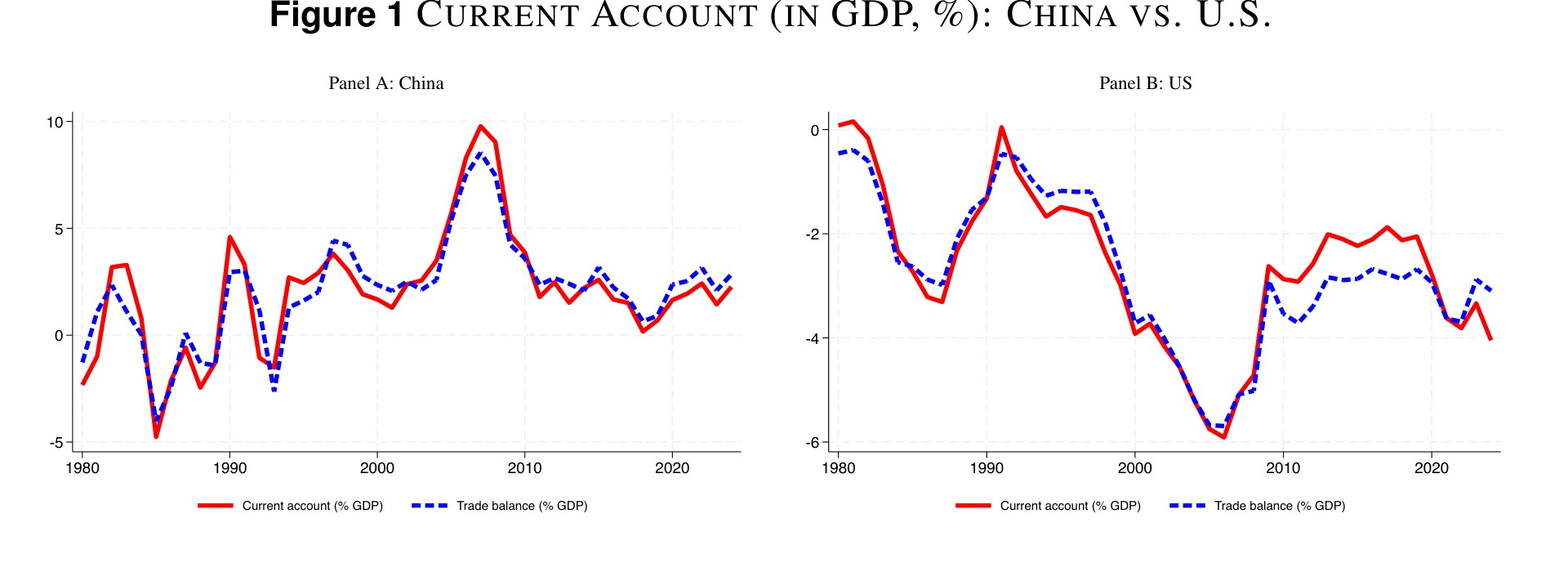
Note: The figure shows the current account balance and trade balance as a percentage of GDP for China and the U.S., from 1980 to 2024. Data sources: IMF World Economic Outlook, October 2025, and World Development Indicators.
The current debate contains several distinct issues. One is measurement: Do official balance-of-payments statistics understate the true size of China’s surplus? Another is industrial policy: Do sectoral subsidies and other interventions mechanically translate into an economy-wide current account surplus? A third issue is housing: Has the recent real estate downturn weakened domestic demand and reduced imports? These debates have appeared in Setser (2025a, 2025b), Gourinchas et al. (2024), Anderson (2025), and related policy discussions. They are related, but they should not be treated as the same question.
We examine these issues together. Our main message is that measurement problems deserve attention, and recent housing weakness has likely mattered for the surplus in the last few years. However, the persistent explanation has to start from China’s savings-investment balance. Structural forces behind high household and corporate savings remain central.
Measurement: important, but not a smoking gun
The first measurement issue concerns the trade balance. China’s goods trade surplus is reported by both Chinese Customs and SAFE. Customs data record physical cross-border movements of goods. SAFE’s balance-of-payments data follow the International Monetary Fund’s change-of-ownership principle. These concepts are related, but not identical. As global value chains, processing trade, and bonded warehouses become more important, the gap between the two can be sizable.
The gap widened after 2019, and the methodological change in China’s balance-of-payments reporting has led to a smaller reported goods surplus than one would obtain from customs data. This has generated understandable concern. But the gap by itself is not enough to conclude that the official current account surplus is understated.
There are several reasons. First, customs imports are reported on a CIF basis, including shipping and insurance costs, which belong to the service account rather than the goods account. Second, the US-China trade war changed firms’ incentives. Higher tariffs create stronger incentives for importers to under-report import values, a mechanism studied by Fisman and Wei (2004). On the export side, higher VAT rebates can strengthen incentives to over-report export values. After adjusting customs data for shipping and insurance, possible tariff evasion on imports, and possible VAT-rebate over-claiming on exports, the customs-based and SAFE-based trade balances become much closer. In this sense, one cannot reject the null that the SAFE-reported goods surplus is compatible with suitably adjusted customs data.
A second measurement issue concerns primary income. China holds a large stock of foreign assets, yet its reported net investment income has been weak, even during a period of high global interest rates. This is puzzling. If China’s foreign assets earned returns similar to those on safe reserve assets, the implied missing income could be large. But the inference depends critically on the return to “other assets,” including bank loans, trade credit, and some Belt-and-Road-related exposures. If some of these assets have low or negative returns, the reported income numbers become easier to rationalize. More disaggregated official information would help resolve this issue.
Alternative explanations and structural forces
A popular explanation for China’s surplus is industrial policy. There is good evidence that subsidies and other policies can expand targeted sectors. For example, research on shipbuilding and other industries shows that sectoral policies can raise production and net exports in targeted sectors (Barwick et al. 2025, Rotunno and Ruta 2024, Jean 2026). This is important. But it does not automatically imply a large, economy-wide current account surplus.
The reason is general equilibrium. A subsidy to export sectors can raise exports, but it can also draw resources away from import-competing sectors, which then raises imports. Similarly, import barriers can reduce imports directly, but by making the economy less open and reallocating resources away from export sectors, they can also reduce exports. This logic is related to the Lerner symmetry theorem: In general equilibrium, a tax on imports is also a tax on exports. A policy can generate a large surplus in one sector without generating an equally large surplus for the whole economy.
The same logic helps us understand why China’s World Trade Organization accession may have contributed to its surplus in a less obvious way. From a partial-equilibrium perspective, import liberalization should raise imports and reduce the trade balance. But Ju et al. (2021) show that, for a developing economy, import liberalization can raise exports by more than imports. Cheaper capital-intensive imports can lower the domestic return to capital, raise desired savings relative to investment, and generate a current account surplus. The lesson is that trade policy can matter, but its effect on the current account often goes through general-equilibrium channels rather than simple import-minus-export arithmetic.
Housing is another important explanation for the recent period. The housing downturn has reduced household wealth, weakened consumption, and depressed import demand. Chen et al. (2024) trace part of the downturn to the 2020 leverage restrictions on real estate developers and document negative spillovers to financial markets and the broader economy. Anderson (2025) emphasizes that weak housing demand has also contributed to China’s recent trade surplus through lower imports. This channel likely matters for the last few years, but it is unlikely to be the enduring driver of China’s external imbalance. It cannot explain the large surplus before 2019, when the housing market was expanding strongly. Moreover, the combined goods and services balance in the balance-of-payments data has not shown a sharp recent surge comparable to the mid-2000s peak. Customs goods data alone suggest a stronger increase, but customs data may exaggerate the goods surplus in recent years.
Exchange-rate policy is also difficult to interpret by itself. A weak real exchange rate can be associated with a current account surplus. But the direction of causality is not obvious. Structural forces that raise savings can also lower the relative price of nontradable goods and create the appearance of real exchange rate undervaluation, a mechanism formalized by Du and Wei (2016) through status competition in the marriage market. In a world with global value chains, measuring the effective real exchange rate is itself complicated. Observing a surplus and a weak real exchange rate is therefore not sufficient to establish exchange-rate policy as the root cause.
In our view, the more durable explanation lies in structural savings forces. China is unusual not only because it runs a surplus, but also because both savings and investment are very high. The surplus exists because savings remain higher than investment. One important structural force is demographics. The competitive savings motive proposed by Wei and Zhang (2011) suggests that a skewed sex ratio can raise household savings, especially among families with sons who compete in the marriage market. This mechanism can account for a sizable part of the increase in household savings before 2007, and the gradual improvement in the sex ratio is consistent with the decline in the surplus after 2010.
Another structural force is financial underdevelopment. Productive private firms often face tighter access to external finance than state-owned firms. They therefore rely more on internal savings to fund investment, as in Song et al. (2011). Household credit constraints can also raise savings. Financial access has improved over time, including through fintech and consumer credit, which helps explain why this force may have weakened. But it remains an important part of the structural story.
These conclusions have policy implications. In the short run, stronger macroeconomic support that addresses deflationary pressure and housing-market weakness can raise domestic demand and imports. In the long run, however, a durable reduction in China’s current account surplus requires reforms that address the sources of high saving. These include policies that correct the sex-ratio imbalance and improve the economic status of women, as well as financial reforms that improve access to credit for productive private firms. Trade and industrial policies may create distortions and sector-level imbalances, but they are unlikely to be the whole story. The current account question is back; the answer is still fundamentally a macroeconomic and structural one.
Chang Ma, International School of Finance, Fudan University; Shang-Jin Wei, Columbia University, CEPR, NBER, and ABFER
References
Anderson, J. 2025. “It’s the Housing Market, Stupid!” Applied Global Macro Research by Emerging Advisors Group.
Barwick, Panle Jia, Myrto Kalouptsidi, and Nahim Bin Zahur. 2025. “Industrial Policy Implementation: Empirical Evidence from China’s Shipbuilding Industry.” Review of Economic Studies 92 (6): 3611–48. https://doi.org/10.1093/restud/rdaf011.
Bernanke, Ben. 2005. “The Global Saving Glut and the US Current Account Deficit.” Virginia Association of Economists. https://www.federalreserve.gov/boarddocs/speeches/2005/200503102/.
Chen, Kaiji, Huancheng Du, and Chang Ma. 2024. “The Spillover Effects of Real Estate.” Working Paper. https://www.aeaweb.org/conference/2025/program/paper/4s4B26S2.
Du, Qingyuan, and Shang-Jin Wei. 2016. “A Darwinian Perspective on ‘Exchange Rate Undervaluation.’” European Economic Review 83: 111–38. https://doi.org/10.1016/j.euroecorev.2015.12.010.
Fisman, Raymond, and Shang-Jin Wei. 2004. “Tax Rates and Tax Evasion: Evidence from ‘Missing Imports’ in China.” Journal of Political Economy 112: 471–96. https://doi.org/10.1086/381476.
Gourinchas, Pierre-Olivier, Ceyla Pazarbasioglu, Krishna Srinivasan, and Rodrigo Valdes. 2024. “Trade Balances in China and the US Are Largely Driven by Domestic Macro Forces.” IMF Blog, September 12, 2024. https://www.imf.org/en/blogs/articles/2024/09/12/trade-balances-in-china-and-the-us-are-largely-driven-by-domestic-macro-forces.
Jean, Sébastien. 2026. “Global Imbalances, Industrial Policies, and the (Reverse) Transfer Problem.”
Ju, Jiandong, Kang Shi, and Shang-Jin Wei. 2021. “Trade Reforms and Current Account Imbalances.” Journal of International Economics 131: 103451. https://doi.org/10.1016/j.jinteco.2021.103451.
Ma, Chang, and Shang-Jin Wei. 2026. “The Chinese Current Account Imbalances: Puzzles, Patterns, and Possible Causes.” National Bureau of Economic Research Working Paper No. 35056. https://www.nber.org/papers/w35056.
Obstfeld, Maurice. 2025. “The US Trade Deficit: Myths and Realities.” Brookings Papers on Economic Activity. https://www.brookings.edu/wp-content/uploads/2025/03/3_Obstfeld.pdf.
Rotunno, Lorenzo, and Michele Ruta. 2024. “Trade Implications of China’s Subsidies.” International Monetary Fund Working Paper No. 2024/180. https://doi.org/10.5089/9798400282478.001.
Setser, Brad W. 2025a. “China’s Massive Surplus Is Everywhere (Yet The IMF Still Has Trouble
Seeing It Clearly.” Council on Foreign Relations, November 12, 2025. https://www.cfr.org/articles/chinas-massive-surplus-everywhere-yet-imf-still-has-trouble-seeing-it-clearly.
Setser, Brad W. 2025b. “The iPhone, the IMF, and China’s Balance of Payments.” Council on Foreign Relations, February 24, 2025. https://www.cfr.org/articles/iphone-imf-and-chinas-balance-payments.
Song, Zheng, Kjetil Storesletten, and Fabrizio Zilibotti. 2011. “Growing Like China.” American Economic Review 101 (1): 196–233. https://doi.org/10.1257/aer.101.1.196.
Wei, Shang-Jin, and Xiaobo Zhang. 2011. “The Competitive Saving Motive: Evidence from Rising
Sex Ratios and Savings Rates in China.” Journal of Political Economy 119 (3): 511–64. https://doi.org/10.1086/660887.

Latest
Most Popular
- VoxChina Covid-19 Forum (Second Edition): China’s Post-Lockdown Economic Recovery VoxChina, Apr 18, 2020
- China’s Great Housing Boom Kaiji Chen, Yi Wen, Oct 11, 2017
- China’s Joint Venture Policy and the International Transfer of Technology Kun Jiang, Wolfgang Keller, Larry D. Qiu, William Ridley, Feb 06, 2019
- The Dark Side of the Chinese Fiscal Stimulus: Evidence from Local Government Debt Yi Huang, Marco Pagano, Ugo Panizza, Jun 28, 2017
- Wealth Redistribution in the Chinese Stock Market: the Role of Bubbles and Crashes Li An, Jiangze Bian, Dong Lou, Donghui Shi, Jul 01, 2020
- Evaluating Risk across Chinese Housing Markets Yongheng Deng, Joseph Gyourko, Jing Wu, Aug 02, 2017
- Daily Price Limits and the Magnet Effect Ting Chen, Zhenyu Gao, Jibao He, Wenxi Jiang, Wei Xiong, Oct 25, 2017
- What Is Special about China’s Housing Boom? Edward L. Glaeser, Wei Huang, Yueran Ma, Andrei Shleifer, Jun 20, 2017
- Privatization and Productivity in China Yuyu Chen, Mitsuru Igami, Masayuki Sawada, Mo Xiao, Jan 31, 2018
- How did China Move Up the Global Value Chains? Hiau Looi Kee, Heiwai Tang, Aug 30, 2017