
A Bridge on Economic Issues between China and the World



 Facebook
  Twitter
  Instagram
 WeChat
  Email
Email Why China’s Monetary Expansion Has Not Brought Back Inflation
China has repeatedly expanded credit to support growth, yet inflation has remained weak. We argue that the puzzle reflects China’s production-oriented monetary regime: credit flows mainly through banks, firms, local governments, and state-prioritized sectors, sustaining production capacity more directly than household demand.
China’s recent macroeconomic puzzle is easy to state but hard to explain. Each time growth has weakened, the People’s Bank of China has responded with credit expansion and liquidity easing. Yet the expected reflation has not arrived. This is puzzling from the perspective of standard monetary transmission, which predicts that monetary easing should stimulate aggregate demand and, after some lag, raise inflation, as shown in classic US evidence by Christiano et al. (2005) and Romer and Romer (2004), as well as cross-country evidence for emerging and developing economies by Brandão-Marques et al. (2020) and Choi et al. (2024). In China, however, producer prices have repeatedly fallen, consumer prices have barely moved, and domestic demand has remained weak. This pattern raises a basic question: Why has monetary expansion in China struggled to translate into stronger prices and spending?
Our recent paper Chang and Xiong (2026), Monetary Policy in Mandarin Capitalism, argues that the answer lies in the institutional structure of China’s economy. China’s monetary policy does not operate mainly through the textbook channel of lower interest rates stimulating household borrowing, consumption, and aggregate demand. Instead, it works through a bank-centered and state-guided financial system that channels credit primarily to firms, local governments, infrastructure projects, and state-prioritized sectors. As a result, monetary expansion tends to sustain production and balance sheets more directly than it stimulates final household demand. The paper’s central finding is that faster monetary-financial expansion temporarily raises producer-price inflation but depresses it over longer horizons.
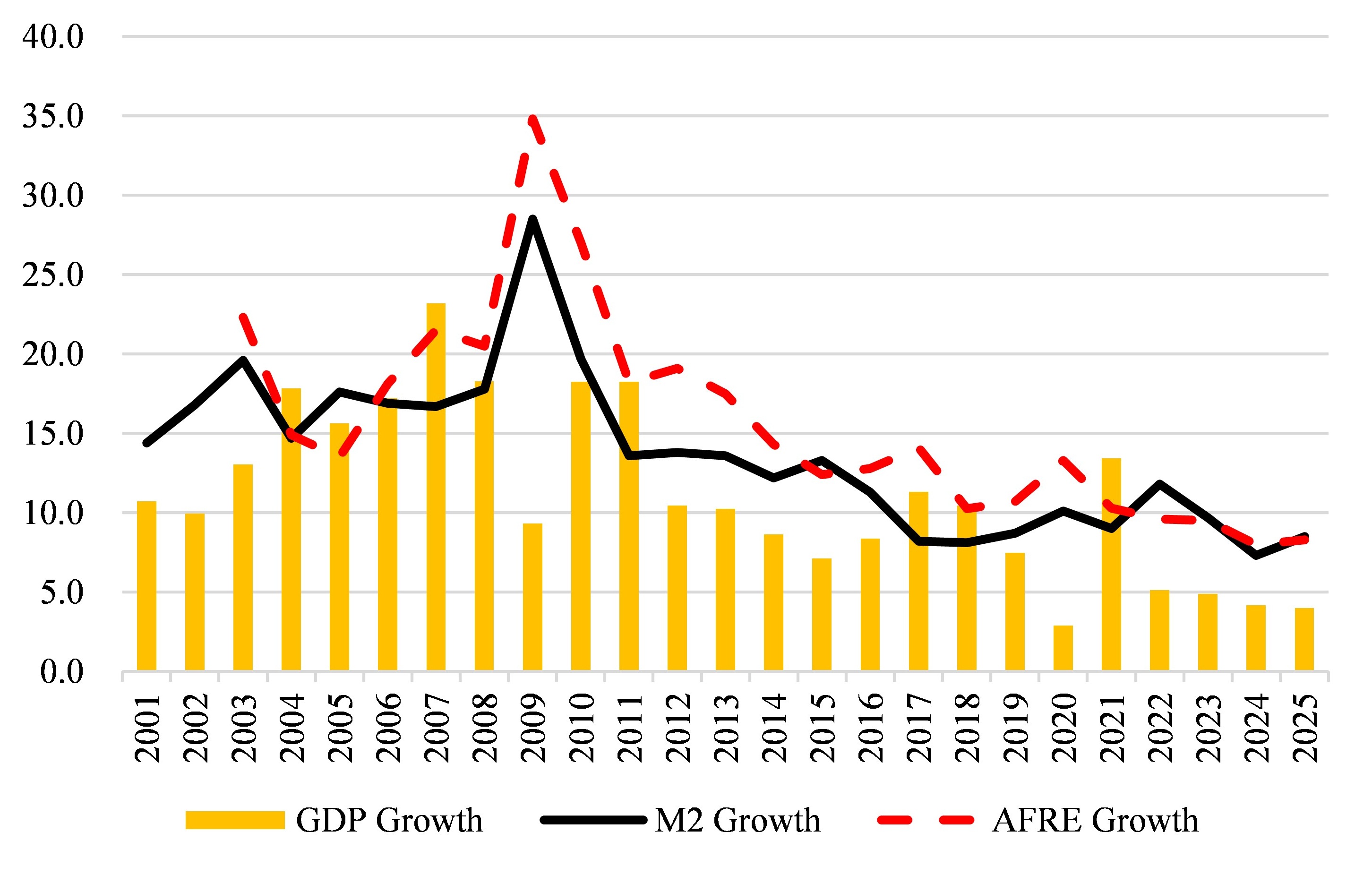
Figure 1 provides the starting point. It plots nominal GDP growth against the growth of M2 and aggregate financing to the real economy (AFRE). The recurrent pattern is clear: When growth falters, monetary and credit growth rise. But the reflationary effect is much weaker than standard monetary logic would predict. The contrast was especially visible after the global financial crisis. China’s nominal GDP growth fell sharply in 2009, and the policy response was massive: M2 growth reached 27.7% and aggregate financing to the real economy grew by 32.3%. Growth rebounded in 2010 and 2011, but the stimulus also left behind severe overcapacity in steel, cement, coal, and glass. The recovery soon faded. From 2012 to 2015, monetary and credit growth remained well above nominal GDP growth, yet producer prices stayed in deflation, with PPI reaching -5.9% in 2015.
Figure 1: Growth Rates of Nominal GDP, M2, and Aggregate Financing
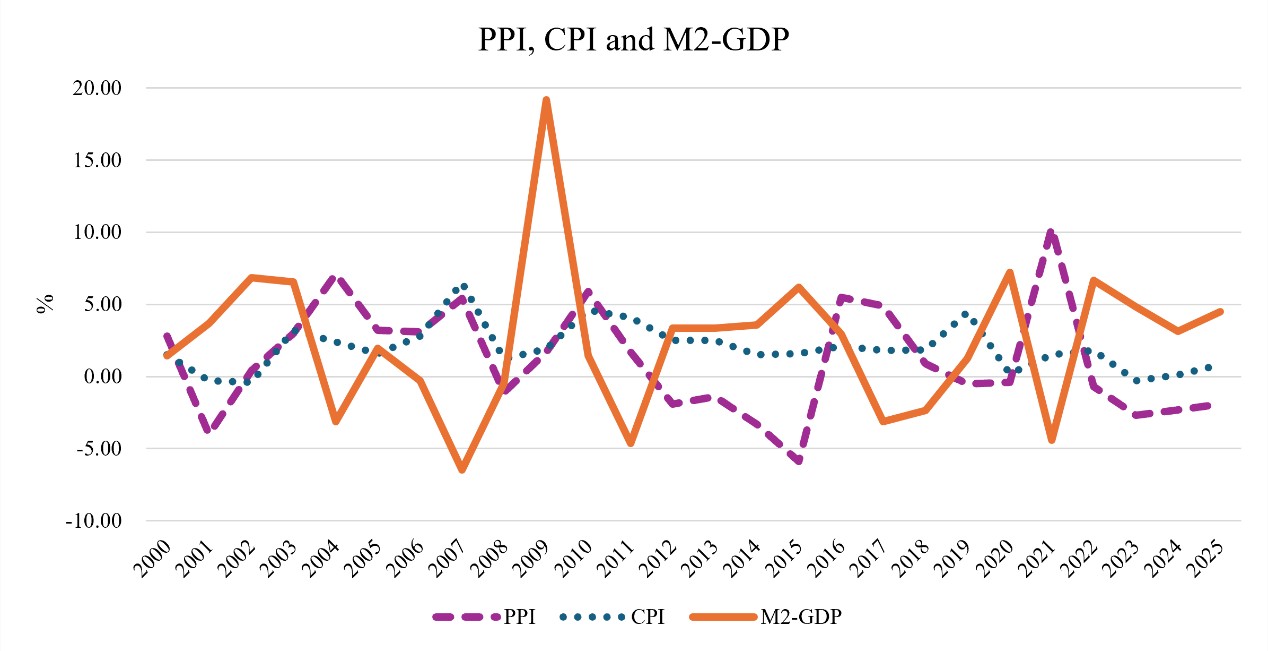
The same pattern repeated after the COVID-19 shock. In 2020, M2 growth ran 7.2 percentage points above nominal GDP growth, but PPI was -0.4% and CPI only 0.2%. From 2022 through 2025, nominal GDP growth slowed further, and monetary accommodation continued. M2 growth exceeded nominal GDP growth by 6.7, 4.8, 3.1, and 4.5 percentage points in these years. Yet the inflationary outcome remained negligible: PPI stayed negative, while CPI hovered near zero. Figure 2 makes this point visually: Repeated monetary expansions were not followed by durable increases in producer or consumer prices.
Figure 2: M2 Growth and Inflation
This is not because Chinese policymakers are indifferent to weak prices or domestic demand. Recent public statements by PBC governors make clear that disinflation has become a policy concern. Governor Pan Gongsheng acknowledged in 2024 that China had already moved in an expansionary direction, but that existing credit was not being absorbed in ways that generated proportionate economic activity. Former Governor Yi Gang similarly argued that China should focus on fighting disinflationary pressure and turning the GDP deflator positive. The policy concern is therefore real. The problem is that the institutional channels of monetary transmission make demand-side reflation difficult.
We interpret this pattern through the framework of Mandarin capitalism, proposed by Xiong (2027). China has integrated many market mechanisms, but these mechanisms remain embedded in a hierarchical state system that retains substantial influence over finance, investment, and industrial development. Within this system, monetary policy is not simply a short-run stabilization tool. It is also a mechanism for coordinating credit expansion with broader state objectives. This role is especially visible in the growing importance of structural monetary policy tools, such as relending, rediscounting, and pledged supplementary lending, which affect not only the total quantity of credit but also its sectoral allocation.
This system has long been organized around production rather than consumption. Like many late-industrializing economies, China built institutions that channel domestic resources into investment, infrastructure, and industrial upgrading. This strategy supported decades of rapid growth. But as the economy matures, the same production-oriented logic creates persistent imbalances: high savings, weak household consumption, repeated investment surges, and excess capacity. In such an environment, credit expansion may support activity and prices in the short run, but over time it can push supply capacity ahead of final demand, generating disinflationary pressure.
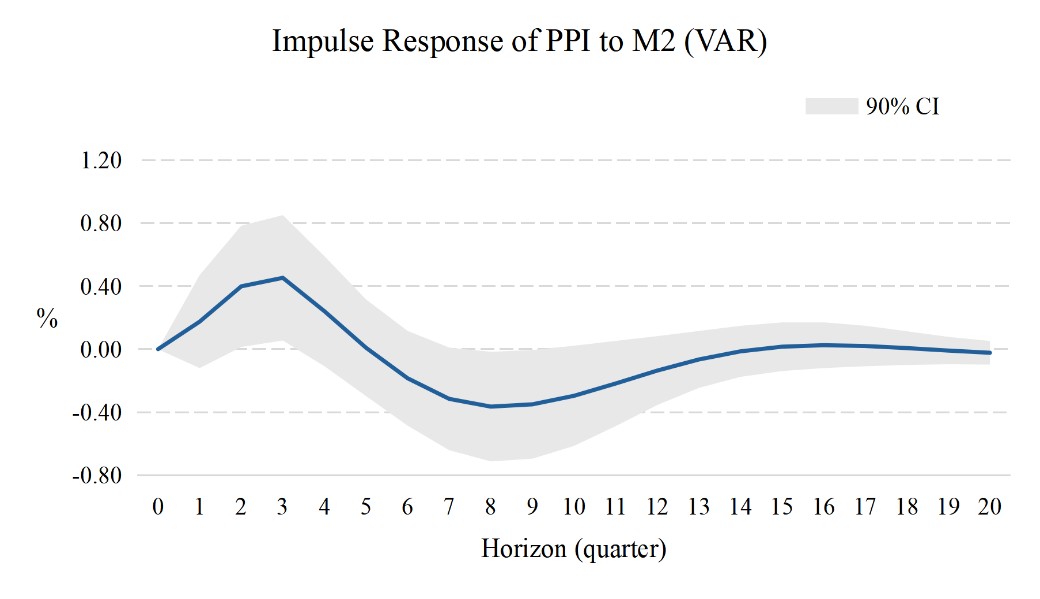
The empirical evidence supports this interpretation. Using quarterly data from 2008Q1 to 2025Q2 and a vector autoregression framework, the paper finds that faster M2 growth is not followed by any significant response in CPI inflation. This already contrasts with the standard monetary intuition that monetary expansion should eventually raise prices. The response of PPI inflation, shown in Figure 3, is even more revealing. Faster M2 growth is followed by a short-run increase in PPI inflation, peaking after roughly three quarters. But this effect then reverses. After about five quarters, the response turns negative, and by around eight quarters it reaches roughly -0.4 percentage points. In other words, monetary expansion is temporarily reflationary for producer prices, but disinflationary over the medium run.
Figure 3: Impact of M2 Growth on PPI Inflation
Why does this happen? The key is that monetary expansion reaches firms more directly than households. Credit supports production, inventories, upstream-downstream pricing, and firm balance sheets. But the same credit impulse reaches households only indirectly, through wages, payments to suppliers, employment income, and other channels. These channels are weak in China because many high-propensity-to-consume households, including rural residents, migrant workers, informal workers, and low-income households, are poorly connected to formal credit chains. As a result, monetary expansion can sustain investment and output without generating enough household spending to absorb the additional production.
The sectoral evidence reinforces this mechanism. Using balance-sheet data for publicly listed industrial firms, our paper constructs industry-level measures of debt growth and relates them to producer prices, profits, leverage, inventories, and capacity utilization. Faster debt growth within an industry is associated with lower producer-price inflation over the next one to four quarters. It is also associated with weaker profit growth, slower inventory turnover, and persistently higher leverage. These patterns suggest that credit expansion sustains production and balance-sheet growth even as pricing power and profitability deteriorate.
Supply-chain evidence points in the same direction. Debt growth in downstream sectors raises upstream PPI inflation, while debt growth in upstream sectors does not generate a corresponding increase in downstream PPI inflation. This asymmetry suggests that producer prices respond mainly to demand pressures transmitted upstream through supply chains, rather than to upstream cost shocks passed downstream. It also shows that China’s monetary expansion operates through production networks, not primarily through household demand.
The policy implication is important for general debates about China’s economy. If weak inflation reflected only insufficient monetary easing, then the solution would be straightforward: Ease more. But if weak inflation reflects the structure of monetary transmission, then more production-side credit may not solve the problem. It may cushion downturns, sustain investment, and prevent sharper balance-sheet stress. But it can also preserve excess capacity, delay adjustment, weaken profitability, and intensify the mismatch between supply and demand.
This does not mean that China’s monetary policy is powerless. Quite the opposite: It is powerful at preserving production, supporting growth objectives, and preventing abrupt collapses. That capacity helps explain why China has avoided a sudden financial crisis even amid property-sector stress and rising debt burdens. But the same strength also creates a limitation. A system designed to mobilize credit toward firms and projects is less effective at stimulating household demand, especially when households remain cautious and social insurance remains incomplete.
For China’s next stage of growth, this distinction is crucial. The challenge is not only to expand credit, but also to change where purchasing power goes. Policies that raise household disposable income, reduce precautionary saving, and improve pension and medical coverage for lower-income households may be more effective for demand rebalancing than additional credit to firms. Monetary policy can support the transition, but it cannot substitute for broader fiscal and social-policy reforms.
The broader lesson is that monetary policy cannot be understood apart from the institutions through which it operates. In China’s Mandarin capitalism, credit expansion is not a neutral injection of demand into a market economy. It is part of a state-guided system for sustaining production, investment, and growth. That system helped power China’s rise. But in an economy now facing weak demand, excess capacity, and disinflationary pressure, the same system can make monetary expansion disinflationary rather than reflationary.
References
Brandão-Marques, Luis, Gaston Gelos, Thomas Harjes, Ratna Sahay, and Yi Xue. 2020. “Monetary Policy Transmission in Emerging Markets and Developing Economies.” International Monetary Fund Working Papers. https://doi.org/10.5089/9781513529738.001.
Chang, Jeffrey (Jinfan), and Wei Xiong. 2026. “Monetary Policy in Mandarin Capitalism.” Asian Economic Policy Review, forthcoming.
Choi, Sangyup, Tim Willems, and Seung Yong Yoo. 2024. “Revisiting the Monetary Transmission Mechanism through an Industry-Level Differential Approach.” Journal of Monetary Economics 145: 103556. https://doi.org/10.1016/j.jmoneco.2024.103556.
Christiano, Lawrence J., Martin Eichenbaum, and Charles L. Evans. 2005. “Nominal Rigidities and the Dynamic Effects of a Shock to Monetary Policy.” Journal of Political Economy 113 (1): 1–45. https://doi.org/10.1086/426038.
Romer, Christina D., and David H. Romer. 2004. “A New Measure of Monetary Shocks: Derivation and Implications.” American Economic Review 94 (4): 1055–84. https://doi.org/10.1257/0002828042002651.
Xiong, Wei. 2027. Mandarin Capitalism: The Market Inside the State and the Paradoxes of China’s Rise. W. W. Norton & Penguin.

Latest
Most Popular
- VoxChina Covid-19 Forum (Second Edition): China’s Post-Lockdown Economic Recovery VoxChina, Apr 18, 2020
- China’s Great Housing Boom Kaiji Chen, Yi Wen, Oct 11, 2017
- China’s Joint Venture Policy and the International Transfer of Technology Kun Jiang, Wolfgang Keller, Larry D. Qiu, William Ridley, Feb 06, 2019
- The Dark Side of the Chinese Fiscal Stimulus: Evidence from Local Government Debt Yi Huang, Marco Pagano, Ugo Panizza, Jun 28, 2017
- Wealth Redistribution in the Chinese Stock Market: the Role of Bubbles and Crashes Li An, Jiangze Bian, Dong Lou, Donghui Shi, Jul 01, 2020
- Evaluating Risk across Chinese Housing Markets Yongheng Deng, Joseph Gyourko, Jing Wu, Aug 02, 2017
- Daily Price Limits and the Magnet Effect Ting Chen, Zhenyu Gao, Jibao He, Wenxi Jiang, Wei Xiong, Oct 25, 2017
- What Is Special about China’s Housing Boom? Edward L. Glaeser, Wei Huang, Yueran Ma, Andrei Shleifer, Jun 20, 2017
- Privatization and Productivity in China Yuyu Chen, Mitsuru Igami, Masayuki Sawada, Mo Xiao, Jan 31, 2018
- How did China Move Up the Global Value Chains? Hiau Looi Kee, Heiwai Tang, Aug 30, 2017