
A Bridge on Economic Issues between China and the World



 Facebook
  Twitter
  Instagram
 WeChat
  Email
Email When Real Estate Stops Driving Growth: Lessons from China and Japan
It is now widely recognized that real estate lies at the heart of the slowdown in China’s growth; the slowdown has been deep and persistent despite the lack of the kind of systemic banking crises that plagued many Asian economies in the late 1990s and many advanced economies during 2008-09. Exploiting a new detailed city level data set covering almost 300 municipalities, we explore the extent to which China’s slowdown can be attributed to overhang of excess real estate and infrastructure, and whether there are any similarities to Japan’s crisis that started in the 1990s. Importantly, we conjecture that other mechanisms are likely at play in real estate boom/bust episodes in addition to the classic Bernanke-style banking crisis, and that China is perhaps not so different.

Over the past five decades, real estate has played a central role in growth models of both Japan and China (Fang et al., 2015; Chen and Wen VoxChina, 2017), first as a leading engine of expansion—Japan in the 70s and 80s, China in the 2000s and 2010s, but then also became a major drag—Japan in 1990s and 2000s, China since 2019. Most analyses of Western real estate collapses have tended to view the events through the lens of financial crisis, ala Bernanke (1983), and certainly Japan experienced a major banking crisis as its real estate problems unfolded. It has, however, been something of a surprise to many that China’s real estate crisis has been so deep and prolonged, given the relatively low household leverage compared to Western benchmarks, high savings rates, and considerable state capacity to resolve allocation of losses in debt workouts far faster than in Europe or the United States. We have argued for some time (Rogoff and Yang, 2020; VoxChina, 2023), that the real side of real estate crises has been perhaps understated in the literature, certainly as applied to the risks in China.
In A Tale of Two Countries—the Real Estate Crises in 1990s Japan and Contemporary China (Rogoff and Yang, 2026), we argue that housing downturns are not merely financial episodes. Even in the absence of an immediate banking collapse, real estate booms can leave enduring economic scars through declining investment returns, excess housing stock, and weakened household demand.
The parallel between Japan after 1990 and China today points to a broader lesson: economies built around real estate-led expansion may face not just cyclical adjustment, but deeper structural challenges.
From growth engine to growth drag
Real estate has an outsized footprint in China’s economy for nearly two decades. At its peak, the sector accounted for more than one-quarter of aggregate demand (Rogoff and Yang, 2021). Yet since around 2018, housing has increasingly shifted from supporting growth to weighing on it.
Japan experienced a similar transition after the collapse of its late-1980s property boom. What followed was not a transitory contraction, but a prolonged period of subdued growth, asset-price deflation, and persistent economic malaise.
Why do housing downturns become so persistent?
As noted above, the dominant common explanation in the policy literature emphasizes financial channels and impaired bank balance sheets. But our findings based on detailed city and prefectural construction data for several decades across China and Japan suggest a deeper and more structural mechanism: the key problem is not only finance, but also the accumulation of too much real estate capital relative to underlying demand. Strikingly, the results for both countries suggest that where overbuilding is the most extreme, subsequent growth and related problems also tend to be worse.
The intuition is simple: Housing is durable, difficult to repurpose, and slow to adjust. Once overbuilding occurs, the excess supply can depress returns and investment for many years.
Measuring the long shadow of overbuilding
To examine real estate and growth dynamics, we construct granular regional datasets covering hundreds of Chinese cities and Japanese prefectures.
The primary empirical challenge is that investment and growth are jointly determined. Regions experiencing rapid expansion naturally attract greater construction activity. To isolate causal effects, we employ a shift-share instrumental-variable framework that combines national real estate investment cycles with predetermined regional exposure to the real estate sector. With nearly 300 cities in the sample, no individual city is large enough to drive the national cycle, making the aggregate “shift” plausibly exogenous to local growth shocks. Identification therefore comes from the fact that a common national cycle generates larger investment responses in cities that were ex ante more dependent on real estate, helping to alleviate concerns about reverse causality.
This approach allows us to identify how regions differentially exposed to real estate booms subsequently performed once the cycle reversed.
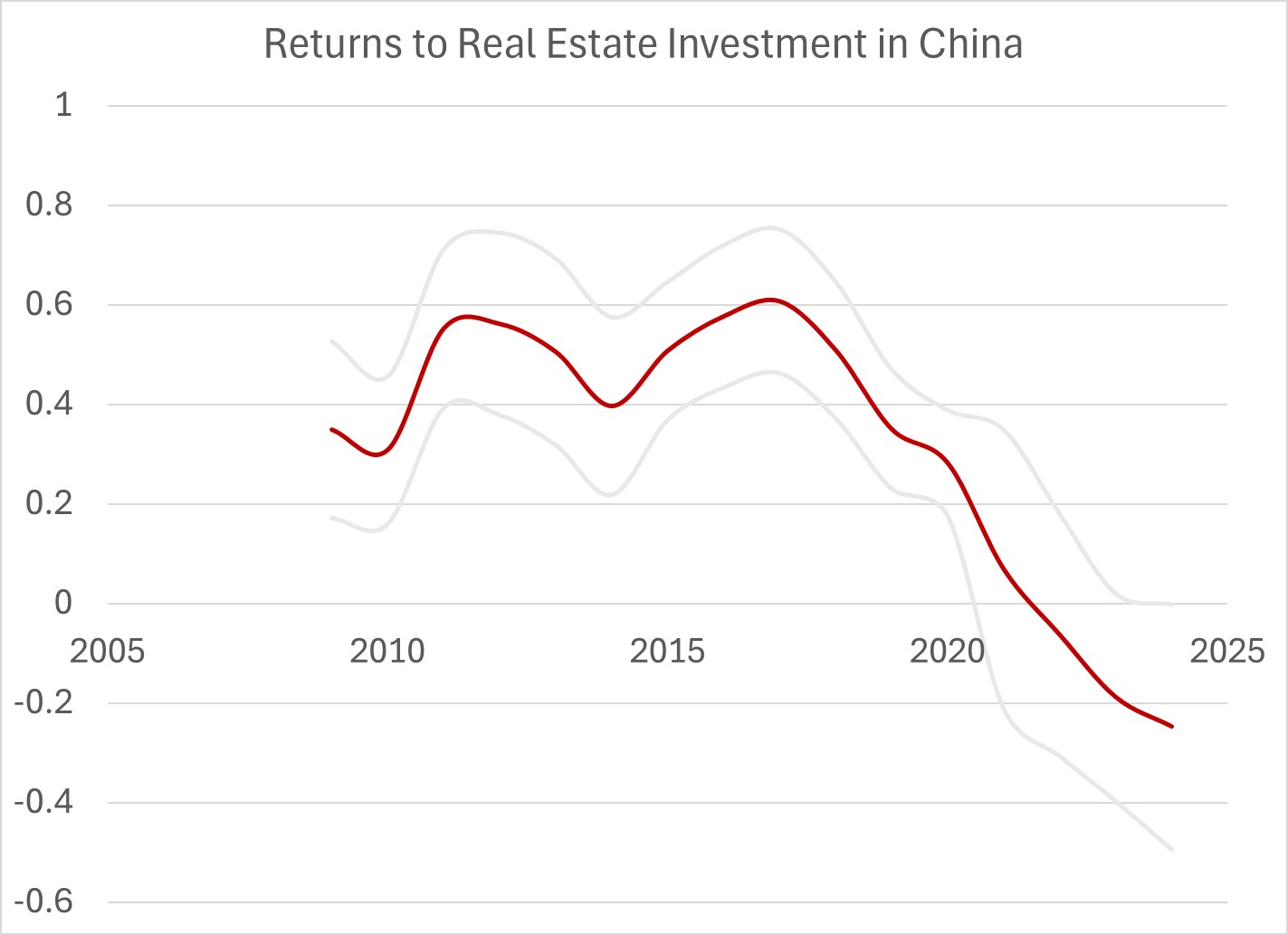
The resulting evidence is striking: In the early stages of the boom, real estate investment strongly supports growth. Over time, however, the marginal returns steadily diminish and eventually turn negative. (Figure 1)
Figure 1. Rolling Window Analysis of Real Estate Investment Returns in China
Sources: National Bureau of Statistics of China, CEIC, and authors’ calculations
In China, the growth contribution of housing investment weakened progressively throughout the 2010s before turning decisively negative after 2019. (Rogoff and Yang, 2024a; 2024b)
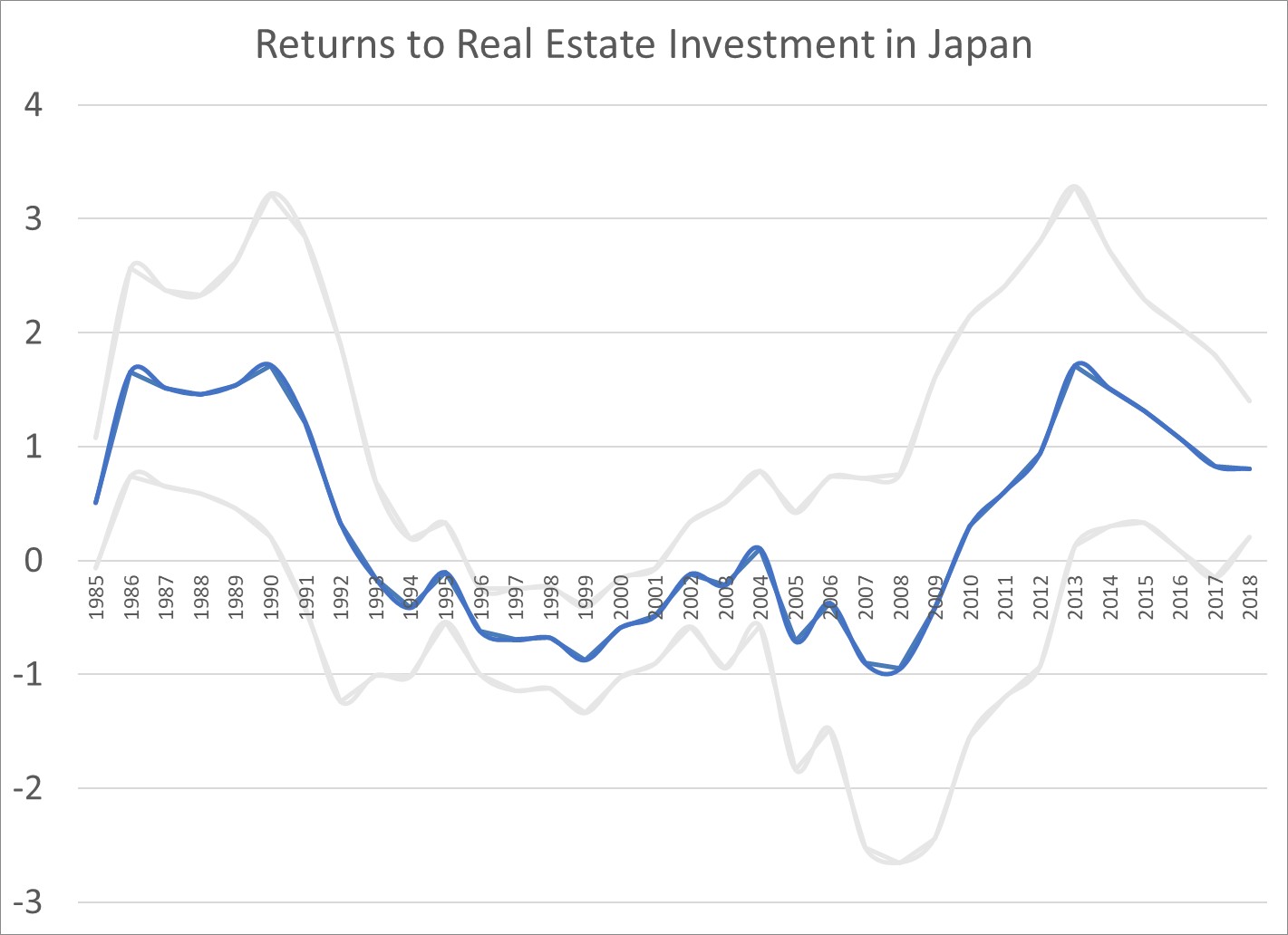
Japan followed a remarkably similar trajectory. Real estate investment boosted activity in the boom years, but contributed negatively to growth following the collapse in land and house prices in the early 1990s. (Figure 2)
Figure 2. Rolling Window Analysis of Real Estate Investment Returns in Japan
Sources: Cabinet Office of Japan, Statistics Bureau of Japan, and authors’ calculations
Investment overhang: The seeds of the downturn are sown during the boom
Our central empirical finding is that regions with larger accumulated housing investment subsequently experience slower economic growth.
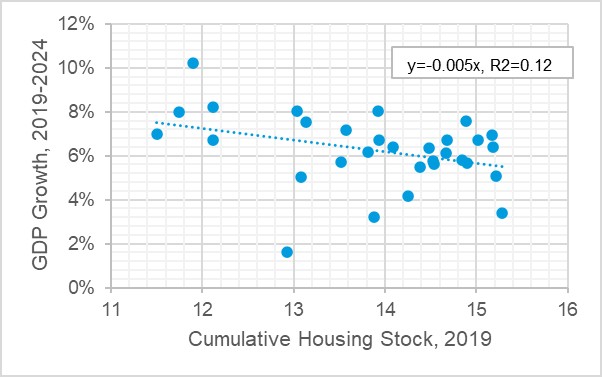
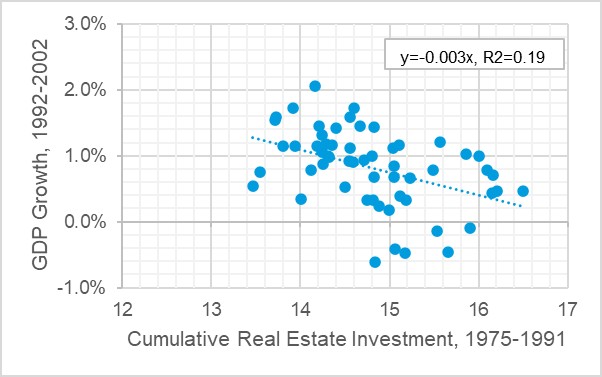
In China, areas that expanded construction more aggressively during the boom have seen more persistent slowdowns in headline growth thereafter. (Figure 3) The interaction between new investment and the inherited stock of real estate is consistently negative and statistically significant. The same cross-sectional pattern holds in Japan. (Figure 4)
Figure 3. Cumulative Housing Stock and Subsequent GDP Growth: China
Sources: Bureau of Statistics of China and authors’ calculations
Figure 4. Cumulative Real Estate Investment and Subsequent GDP Growth: Japan
Sources: Cabinet Office of Japan and authors’ calculations
Notes: The figure plots prefecture-level cumulative investment stock from 1975-1991 against average GDP growth from 1992-2002. Each point corresponds to a prefecture in Japan.
Intuitively, booms begin with surging investment, rapid construction, and rising prices that feed on themselves and encourage even more building. But as excess supply builds, returns fall. When the cycle turns, the overhang of existing housing stock suppresses future investment and growth for years.
This dynamic closely resembles what Rognlie, Shleifer, and Simsek describe as an “investment hangover.” (Rognlie, Shleifer, and Simsek, 2018; Gao, Sockin, and Xiong, 2020) The problem is not simply financial panic. It is the real misallocation of capital into an overbuilt sector.
Beyond investment: amplification through consumption and sentiment
The data also show that overbuilding strongly predicts future declines in house prices.
In China, cities that experienced faster real estate investment growth before 2018 subsequently saw larger declines in house prices. A one-percentage-point increase in pre-2018 housing investment growth predicts roughly a 0.5 percentage point larger decline in subsequent house prices.
Investment overhang, therefore, is only part of the story. Housing downturns also transmit powerfully through the household sector—especially in China, where housing accounts for roughly 70 percent of household wealth. (Figure 5) As a result, falling house prices have particularly pronounced effects on consumption.
Figure 5. Valuation of Different Asset Classes in Trillion Dollars (2017)
Sources: World Bank, BIS, National Bureau of Statistics of China, Bank of Japan, FRED, Zillow, and authors’ calculations
Using an instrumental-variable approach (Guren et al., 2021), we estimate that the elasticity of consumption with respect to house prices in China lies between 0.15 to 0.23. These estimates are substantially larger than those typically seen in the United States or Japan, reflecting the exceptionally concentrated role of housing within Chinese household portfolios. Given observed declines in national house prices, the implied reduction in consumption amounts to about 2–4 percent of China’s GDP.
Another important finding is the role of sentiment.
Using large language model-based measures of housing sentiment, we find that negative housing sentiment more than doubles the consumption response to falling house prices. Sentiment amplifies the downturn by creating a feedback loop in which falling prices generate pessimistic expectations, pessimism weakens consumption, weaker demand slows growth, and slower growth exerts further pressure on housing markets.
In other words, sentiment transforms what might otherwise have been a manageable adjustment into a prolonged economic slump. The results echo classical notions of “animal spirits,” though now rendered empirically measurable through modern data techniques. (Zhao and Chen, 2020)
Rethinking real estate crises
Temin (1976) attributed the Depression largely to real-side forces, whereas the modern literature following Bernanke (1983) has emphasized how the ensuing financial paralysis is a key element of why economies take so long to recover when a real estate bubble bursts. The experiences of Japan in the 1990s and China today suggest that real estate booms can evolve into long-lasting growth traps even without an acute financial sector collapse.
The essential mechanism is the interaction between excessive investment, declining returns, housing wealth effects, and expectation-driven demand weakness. Together, these forces can suppress economic dynamism long after the initial boom has ended.
In economies where housing constitutes the dominant repository of household wealth, policies aimed solely at stabilizing credit conditions may prove inadequate; restoring confidence and reviving household effective demand may be as important as repairing financial balance sheets themselves.
References
Bernanke, B., 1983. Nonmonetary Effects of the Financial Crisis in the Propagation of the Great Depression, American Economic Review 73: 257-76.
Chen, K., Y. Wen, 2017. China’s Great Housing Boom. VoxChina Oct 11, 2017.
Chen, K., Y. Zhao. 2024. Chinese Housing Market Sentiment Index: A Generative AI Approach and An Application to Monetary Policy Transmission. IMF Working Paper No. 2024/264.
Fang, H., G. Gu, W. Xiong, and L. Zhou, 2015. Demystifying the Chinese Housing Boom. NBER Macroeconomics Annual Volume 30.
Gao, Z., M. Sockin, and W. Xiong, 2020. Economic Consequences of Housing Speculation. Review of Financial Studies 33(11): 5248-5287.
Guren, A.M., A. McKay, E. Nakamura, J. Steinsson, 2021. Housing Wealth Effects: The Long View. Review of Economic Studies 88 (2): 669-707.
Rognlie, M., A. Shleifer, A. Simsek. 2018. Investment Hangover and the Great Recession. American Economic Journal: Macroeconomics 10(2): 113-153.
Rogoff, K., and Y. Yang, 2020. Peak China Housing. NBER Working Paper No. 27697.
Rogoff, K., and Y. Yang, 2021, Has China's Housing Production Peaked?, China and the World Economy 21(1): 1-31.
Rogoff, K., and Y. Yang, 2023. A Tale of Tier 3 Cities. VoxChina Mar 29, 2023.
Rogoff, K., and Y. Yang, 2024a. A Tale of Tier 3 Cities. Journal of International Economics 152: 103989.
Rogoff, K., and Y. Yang, 2024b. Rethinking China’s Growth. Economic Policy 39(119): 517-548.
Rogoff, K., and Y. Yang, 2026. A Tale of Two Countries. NBER Working Paper No. 35054.
Temin, P., 1976. Did Monetary Forces Cause the Great Depression? New York: W. W. Norton and Co., 1976. Pp. xiii, 201. - Volume 37 Issue 2.

Latest
Most Popular
- VoxChina Covid-19 Forum (Second Edition): China’s Post-Lockdown Economic Recovery VoxChina, Apr 18, 2020
- China’s Great Housing Boom Kaiji Chen, Yi Wen, Oct 11, 2017
- China’s Joint Venture Policy and the International Transfer of Technology Kun Jiang, Wolfgang Keller, Larry D. Qiu, William Ridley, Feb 06, 2019
- The Dark Side of the Chinese Fiscal Stimulus: Evidence from Local Government Debt Yi Huang, Marco Pagano, Ugo Panizza, Jun 28, 2017
- Wealth Redistribution in the Chinese Stock Market: the Role of Bubbles and Crashes Li An, Jiangze Bian, Dong Lou, Donghui Shi, Jul 01, 2020
- Evaluating Risk across Chinese Housing Markets Yongheng Deng, Joseph Gyourko, Jing Wu, Aug 02, 2017
- Daily Price Limits and the Magnet Effect Ting Chen, Zhenyu Gao, Jibao He, Wenxi Jiang, Wei Xiong, Oct 25, 2017
- What Is Special about China’s Housing Boom? Edward L. Glaeser, Wei Huang, Yueran Ma, Andrei Shleifer, Jun 20, 2017
- Privatization and Productivity in China Yuyu Chen, Mitsuru Igami, Masayuki Sawada, Mo Xiao, Jan 31, 2018
- How did China Move Up the Global Value Chains? Hiau Looi Kee, Heiwai Tang, Aug 30, 2017