
A Bridge on Economic Issues between China and the World



 Facebook
  Twitter
  Instagram
 WeChat
  Email
Email Air Pollution, Financial Mistakes, and Credit Allocation
Air pollution is widely recognized as a major public health concern, but a growing body of research shows that its consequences extend far beyond health outcomes, affecting cognitive performance and economic behavior in domains such as labor productivity and educational outcomes (Aguilar-Gomez et al. 2022; Chang et al. 2016, 2019; Currie et al. 2009). Building on this literature, we show that air pollution can also induce financial mistakes in routine credit-market decisions. Using detailed repayment records from a large Chinese peer-to-peer lending platform, we find that borrowers are significantly more likely to miss scheduled repayments on polluted days, with these missed payments being short-lived and cured once air quality improves. Because the lending platform penalizes such missed payments in the same way as other delinquencies, pollution-induced mistakes can lower borrowers’ credit ratings and reduce their future access to credit.
Existing research in financial markets has shown that pollution can affect decisions that require substantial attention and cognitive effort, such as stock trading or housing transactions (Huang et al. 2020, Li et al. 2021, Meyer and Pagel 2024, Qin et al. 2019). However, much less is known about whether pollution also affects routine financial decisions that are cognitively simple but economically important. This question is particularly relevant because many everyday financial activities—such as loan repayments, bill payments, and contract obligations—follow fixed schedules. Unlike discretionary decisions, these obligations cannot easily be postponed when individuals feel unwell or distracted. As a result, even for borrowers who are financially capable of fulfilling their obligations, such temporary environmental shocks may lead to mistakes that have lasting implications for credit access.
In our recent paper (Li et al. 2025), we study this question using detailed repayment records from a large peer-to-peer lending platform in China. The platform matches individual borrowers with online investors, and borrowers make repayments online through the platform, with each loan installment assigned a pre-specified due date. The granularity of the data allows us to observe the exact scheduled repayment dates for hundreds of thousands of loan installments across cities and over time, making it possible to match repayment behavior precisely with local air pollution conditions.
As shown in Figure 1, the likelihood that a borrower misses a scheduled repayment rises monotonically with the level of air pollution on the due date. When air quality deteriorates from “excellent” to “severely polluted,” the probability of late payment increases by 143.3 basis points, or 11.3% of the sample average. This effect is especially pronounced among borrowers with greater exposure to air pollution, such as those working in industries that require more outdoor activity. Importantly, this effect is both immediate and short-lived. As shown in Figure 2, air pollution affects repayment behavior only on the scheduled repayment day; pollution on preceding or subsequent days has little effect. Late repayments induced by pollution are also more likely to be cured once air quality improves. Taken together, these patterns suggest that the effect is unlikely to operate through changes in borrowers’ underlying financial conditions, which would typically evolve more gradually.
Figure 1. PM2.5 Category and Credit Repayment Behavior
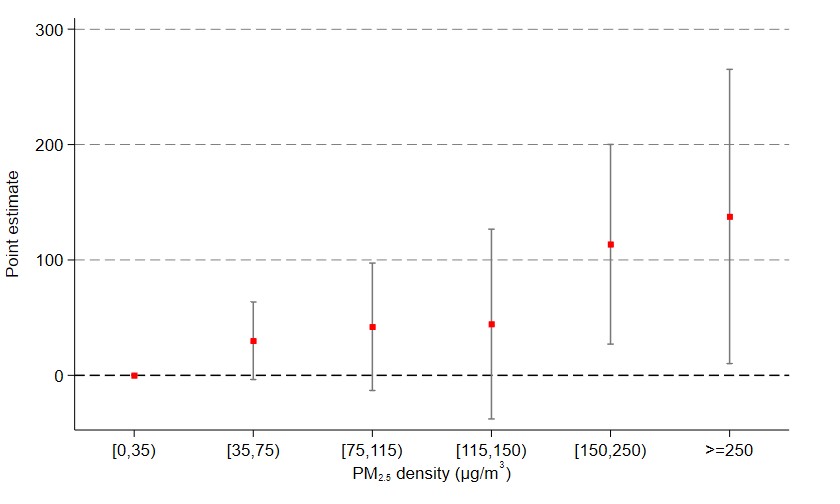
Notes: This figure shows the coefficient estimates on the PM2.5 category indicators and the 95% confidence intervals. The outcome variable is “Delinquency,” a dummy equal to one if the actual repayment date is behind the scheduled repayment date, but the borrower eventually paid off the amount as of our data retrieval date (i.e., February 2020). For ease of interpretation, the outcome variable is multiplied by 10,000 (i.e., expressed as basis points).
Figure 2. Air Pollution and Credit Repayment Behavior: Dynamic Estimate
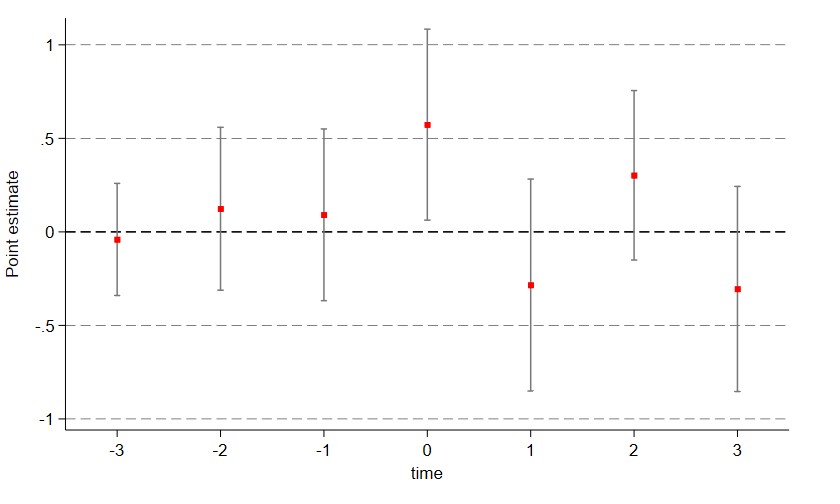
Notes: This figure shows the dynamic effects of air pollution on borrowers’ inclination to miss repayments, along with the 95% confidence intervals. For ease of interpretation, the outcome variable is multiplied by 10,000 (i.e., expressed as basis points). Negative values of the x-axis show the lag effects; positive values show the lead effects; time=0 shows the contemporaneous effect.
We explore several potential explanations for this result. One possibility is that pollution reduces income or increases financial stress. However, the increase in late payments is driven primarily by short-term delinquencies rather than long-term defaults, and borrowers who miss payments on polluted days are more likely to catch up quickly once air quality improves. In addition, the effect is not stronger among borrowers with higher debt burdens, who should be most vulnerable to income shocks. We also consider traffic congestion and other nonfinancial frictions. Because repayments are made online and can be completed within a 24-hour window, such frictions are unlikely to directly disrupt repayment; moreover, our additional tests using congested cities and precipitation do not support this explanation.
Instead, the results point more to a cognitive mechanism: air pollution may make people less attentive or more forgetful. Debt repayments are usually planned in advance and only require borrowers to remember the due date and complete a simple online transaction. When pollution causes discomfort or undermines short-term cognitive performance, borrowers may be more likely to overlook repayment. This explanation is consistent with our finding that the effect is stronger among individuals whose health is more vulnerable to short-term pollution exposure, and on workdays, when people have less mental bandwidth for non-work-related tasks. By contrast, the effect is weaker among heavily indebted borrowers, likely because the high cost of delinquency relative to income makes repayment obligations more salient. The effect is also weaker in areas where local residents pay greater attention to the platform, consistent with the idea that social interaction and information sharing may serve as reminders of upcoming repayments (Hirshleifer 2020) and help offset the adverse effects of air pollution.
Although missing a repayment due to pollution may seem to be a minor mistake, the consequences can be substantial. Late payments lead to penalties and, more importantly, to lower credit ratings on the lending platform. These ratings affect borrowers’ chances of obtaining loans in the future. We find that the lending platform does not distinguish between late payments caused by temporary environmental conditions and those caused by genuine financial distress. As a result, borrowers who miss payments on polluted days face the same deterioration in credit ratings and thus future credit access as genuinely delinquent borrowers.
Taken together, our findings suggest that environmental conditions can affect economic outcomes through behavioral channels that are often overlooked. By impairing attention, memory, and decision making, pollution may impose costs beyond those captured by conventional measures of health or productivity. These effects are particularly relevant in financial settings, where even small mistakes can have lasting consequences. More broadly, our results highlight the need for financial systems to adapt to air pollution, in order to reduce environmentally induced financial mistakes and the resulting distortions in credit allocation.
References
Aguilar-Gomez, Sandra, Holt Dwyer, Joshua Graff Zivin, J., and Matthew Neidell. 2022. “This Is Air: The ‘Nonhealth’ Effects of Air Pollution.” Annual Review of Resource Economics 14 (1): 403–25. https://doi.org/10.1146/annurev-resource-111820-021816.
Chang, Tom Y., Joshua Graff Zivin, Tal Gross, and Matthew Neidell. 2016. “Particulate Pollution and the Productivity of Pear Packers.” American Economic Journal: Economic Policy 8 (3): 141–69. https://doi.org/10.1257/pol.20150085.
Chang, Tom Y., Joshua Graff Zivin, Tal Gross, and Matthew Neidell, M. 2019. “The Effect of Pollution on Worker Productivity: Evidence from Call Center Workers in China.” American Economic Journal: Applied Economics 11 (1): 151–72. https://doi.org/10.1257/app.20160436.
Currie, Janet, Eric A. Hanushek, E. Megan Kahn, Matthew Neidell, and Steven G. Rivkin. 2009. “Does Pollution Increase School Absences?” Review of Economics and Statistics 91 (4): 682–94. https://doi.org/10.1162/rest.91.4.682.
Hirshleifer, David. 2020. “Presidential Address: Social Transmission Bias in Economics and Finance.” Journal of Finance 75 (4): 1779–1831. https://doi.org/10.1111/jofi.12906.
Huang, Jiekun, Nianhang Xu, and Honghai Yu. 2020. “Pollution and Performance: Do Investors Make Worse Trades on Hazy Days?” Management Science 66 (10): 4455–76. https://doi.org/10.1287/mnsc.2019.3402.
Li, Jianwen, Keyang Li, and Yuan Ren. 2025. “Missing Repayments on Haze Days: Evidence from China.” Journal of Development Economics 175: 103491. https://doi.org/10.1016/j.jdeveco.2025.103491.
Li, Jennifer (Jie), Massimo Massa, Hong Zhang, and Jian Zhang. 2021. “Air Pollution, Behavioral Bias, and the Disposition Effect in China.” Journal of Financial Economics 142 (2): 641–73. https://doi.org/10.1016/j.jfineco.2019.09.003.
Meyer, Steffen, and Michaela Pagel. 2024. “Fresh Air Eases Work—The Effect of Air Quality on Individual Investor Activity.” Review of Finance 28 (3): 1105–49. https://doi.org/10.1093/rof/rfae005.
Qin, Yu, Jing Wu, and Jubo Yan. 2019. “Negotiating Housing Deal on a Polluted Day: Consequences and Possible Explanations.” Journal of Environmental Economics and Management 94: 161–87. https://doi.org/10.1016/j.jeem.2019.02.002.

Latest
Most Popular
- VoxChina Covid-19 Forum (Second Edition): China’s Post-Lockdown Economic Recovery VoxChina, Apr 18, 2020
- China’s Great Housing Boom Kaiji Chen, Yi Wen, Oct 11, 2017
- China’s Joint Venture Policy and the International Transfer of Technology Kun Jiang, Wolfgang Keller, Larry D. Qiu, William Ridley, Feb 06, 2019
- The Dark Side of the Chinese Fiscal Stimulus: Evidence from Local Government Debt Yi Huang, Marco Pagano, Ugo Panizza, Jun 28, 2017
- Wealth Redistribution in the Chinese Stock Market: the Role of Bubbles and Crashes Li An, Jiangze Bian, Dong Lou, Donghui Shi, Jul 01, 2020
- Evaluating Risk across Chinese Housing Markets Yongheng Deng, Joseph Gyourko, Jing Wu, Aug 02, 2017
- Daily Price Limits and the Magnet Effect Ting Chen, Zhenyu Gao, Jibao He, Wenxi Jiang, Wei Xiong, Oct 25, 2017
- What Is Special about China’s Housing Boom? Edward L. Glaeser, Wei Huang, Yueran Ma, Andrei Shleifer, Jun 20, 2017
- Privatization and Productivity in China Yuyu Chen, Mitsuru Igami, Masayuki Sawada, Mo Xiao, Jan 31, 2018
- How did China Move Up the Global Value Chains? Hiau Looi Kee, Heiwai Tang, Aug 30, 2017