
A Bridge on Economic Issues between China and the World



 Facebook
  Twitter
  Instagram
 WeChat
  Email
Email Why Lifting Birth Quotas Cannot Reverse Fertility Decline: Evidence from China's Universal Two-Child Policy
Drawing on nationally representative data from the 2017 China Fertility Survey and exploiting the eligibility variation created by China's Universal Two-Child (UTC) policy adopted in January 2016, we find that the policy increased births by only 0.023 per eligible woman in 2016–2017, driven almost exclusively by women who desired two or more children. County-level evidence from the 2020 population census data further shows that fertility in 2016–2020 rose primarily in places with higher average desired fertility, indicating that post-One Child Policy (OCP) China’s low fertility reflects declining demand for children rather than remaining policy constraints.

The Global Fertility Puzzle
Total fertility rates have fallen below replacement levels across much of the world (United Nations 2024). Governments that once enforced strict family planning—most notably China—have rushed to dismantle population controls, expecting a rapid rebound in births. The hope was intuitive: decades of suppressed fertility should have created pent-up demand, like a compressed spring waiting to be released. Yet the spring never snapped back. From East Asia to Southern Europe, fertility rates have continued to drift downward even after restrictions were loosened, raising a fundamental question for policymakers everywhere: why does fertility respond so reluctantly when birth controls are lifted?
A growing body of research suggests the answer lies in what demographers have long emphasized—women's desired fertility is the primary determinant of actual childbearing (Easterlin 1975; Pritchett 1994). Most low-fertility countries now face the problem that women’s desired fertility has fallen below policy ceilings, rendering quota relaxations ineffective. In a recent paper (Fang and Liu 2026), we test this hypothesis directly using China's Universal Two-Child (UTC,全面二孩) policy—one of the largest relaxations of birth restrictions in history.
Figure 1 tells the story at a glance. The UTC policy triggered a brief uptick in births in 2016, but both the birth rate and total fertility rate quickly resumed their downward slide—falling even more steeply after 2017. The “compressed spring” never materialized; a more apt analogy is that the rope was already slack.
Figure 1. China’s Birth Rate and Total Fertility Rate, 2011-2023
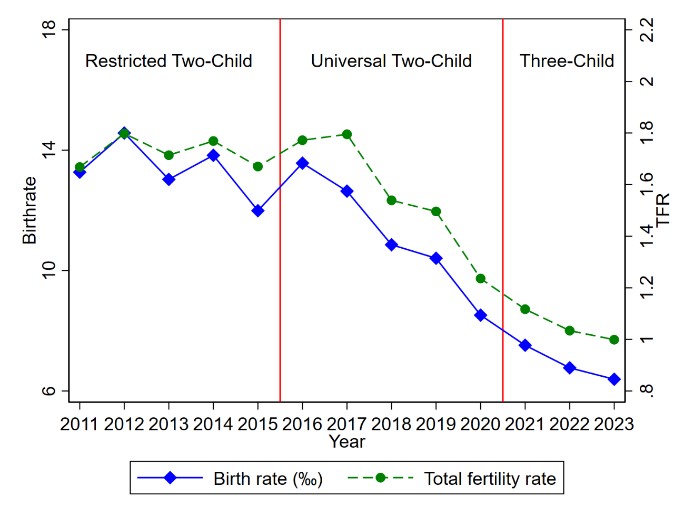
Notes: Birth rate = total births / average annual population × 1000. The three shaded regions mark China's successive policy regimes: the Restricted Two-Child policies (2011–2015), the Universal Two-Child Policy (2016–2020), and the Three-Child Policy (2021–present). The UTC policy produced only a transient spike in 2016; both indicators resumed their decline shortly after. Data source: Birth rate from China's National Bureau of Statistics; total fertility rate from the United Nations Population Division World Population Prospects.
China's Family Planning Policies
After more than three decades under the One-Child Policy (OCP), the Chinese government implemented a series of incremental relaxations. The “Single-Only” Two-Child Policy (2014–2015 单独二孩) allowed a second child if either spouse was an only child, but only about 17% of eligible couples even applied. Then, effective January 1, 2016, the UTC policy permitted all couples to have two children without prior approval. This created a nationwide, abrupt policy change for a clearly defined group—married women with one child whose prior ineligibility stemmed solely from both spouses having siblings. Crucially, this shift occurred at a moment when Chinese women's desired fertility had already fallen to low levels.
Desired Fertility as the Binding Constraint
Using the nationally representative 2017 China Fertility Survey—covering nearly 250,000 women across 2,737 counties—we document that close to 89% of Chinese women aged 20–40 desire no more than two children. The distribution is remarkably compressed: only about 11% want three or more. This means the UTC policy, by raising the ceiling to two, effectively removed binding quotas for the vast majority.
What drives this low desired fertility? We find four key social, individual and economic factors. First, and most powerfully, counties and cohorts that experienced larger historical fertility reductions—the cumulative legacy of the “Later, Longer, Fewer” (晚、稀、少) campaign and the OCP—report systematically lower fertility desires today. A one-standard-deviation increase in this historical “fertility drop” is associated with a 0.046 reduction in desired number of children, a larger effect than either housing costs or education competition. Second, whether the woman herself has siblings. An additional sibling is associated with a 0.4 increase in desired fertility. Third, rising childrearing costs—proxied by housing prices—are negatively associated with fertility desires, consistent with Meng et al. (2023). Fourth, intense education competition, measured by the density of private tutoring institutions, further depresses desires, echoing findings from Kim et al. (2024) on Korea's “education fever.”
A Modest Policy Effect, Driven Entirely by Fertility Desire
Exploiting the eligibility variation created by the UTC reform in a difference-in-differences framework, we find that the policy increased births by only 0.023 per eligible woman per year in 2016–2017—roughly 700,000 additional births annually, or about 3.8% of China's total births. This represents only about 10.4% of the estimated “fertility potential” implied by the gap between desired and realized fertility.
The critical finding emerges when we disaggregate by fertility desire. Figure 2 presents the event-study estimates for women with high desire (two or more children) and low desire (zero or one), separately. Before the UTC policy, the two groups followed nearly identical fertility trajectories—supporting the parallel-trends assumption. After 2016, however, a striking divergence appears: women with high fertility desire sharply increased their births, while women with low desire showed virtually no response. The UTC policy effect is almost entirely accounted for by women who already wanted a second child.
Figure 2. Effects of the UTC Policy on Women with High vs. Low Fertility Desires
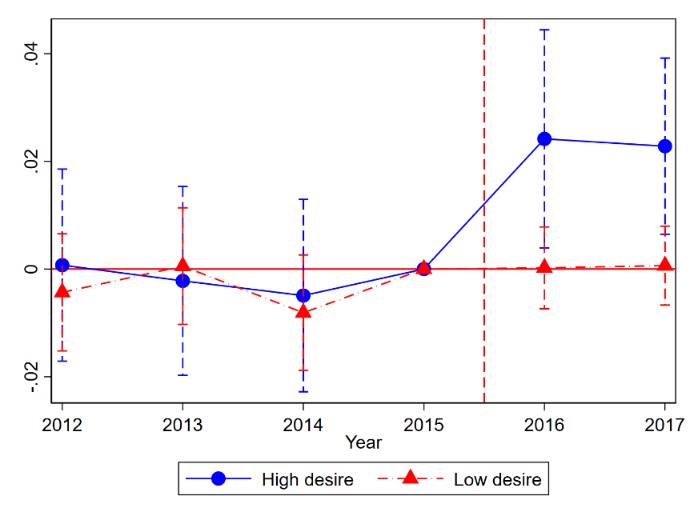
Notes: This figure reports event-study estimates of the UTC policy's effect on annual births, separately for women with high fertility desire (desired two or more children, solid blue line with circles) and low fertility desire (desired zero or one child, dashed red line with triangles). The reference year is 2015 (the last pre-policy year). The dashed vertical line marks the introduction of the UTC policy in January 2016. Before the policy, both groups show statistically indistinguishable pre-trends. After 2016, births rise sharply among high-desire women while remaining flat among low-desire women, indicating that the policy effect was driven almost exclusively by women who already desired a second child. Bars represent 95% confidence intervals. Data source: 2017 China Fertility Survey.
County-level evidence from the 2020 Population Census reinforces this pattern over a longer horizon. Fertility in 2016–2020 rose primarily in counties where average desired fertility was higher, with the effect concentrated exclusively in above-median-desire counties. Projections based on stated fertility plans suggest the effect peaked within three years and then faded as pent-up demand was exhausted.
Implications for Pro-natalist Policy
Two structural headwinds make China's fertility outlook particularly sobering. The number of women of reproductive age (20–40) has been declining steadily since 2015 and is projected to fall further through 2035, a direct consequence of decades of low birth rates reshaping the population pyramid. Simultaneously, average desired fertility among these women is projected to decline from 1.78 in 2016 to 1.63 by 2035 as younger, lower-desire cohorts replace older ones.
These findings carry a clear message: further quota-based reforms—including the Universal Three-Child Policy (全面三孩政策) adopted in 2021—are unlikely to reverse China's fertility decline, because the binding constraint is no longer administrative but preferential. The metaphor matters: what policymakers thought was a compressed spring was, by the time they released it, a slack rope.
The lesson extends well beyond China. Across East Asia, Southern Europe, and other low-fertility regions, policymakers have discovered that removing restrictions is far easier than rebuilding desire. Effective pro-natalist policy must therefore go beyond lifting quotas to address the structural forces—housing costs, education competition, and the cultural legacies of past population control—that have reshaped how families think about children. Without interventions that raise desired fertility itself, the scope for any pro-natalist reform to generate sustained increases in childbearing remains inherently narrow.
(Hanming Fang, Norman C. Grosman Professor of Economics, University of Pennsylvania, and Special-Term Visiting Professor, Fudan University; Chang Liu, Associate Professor, Renmin University of China)
References
Easterlin, R.A. (1975), An Economic Framework for Fertility Analysis, Studies in Family Planning 6(3): 54–63.
Fang, H. and C. Liu (2026), Desired Fertility, Realized Fertility and the Effects of China's Universal Two-Child Policy, Journal of Development Economics 182: 103796.
Kim, S., M. Tertilt, and M. Yum (2024), Status Externalities in Education and Low Birth Rates in Korea, American Economic Review 114(6): 1576–1611.
Meng, L., L. Peng, and Y. Zhou (2023), Do Housing Booms Reduce Fertility Intentions? Evidence from the New Two-Child Policy in China, Regional Science and Urban Economics 101: 103920.
Pritchett, L.H. (1994), Desired Fertility and the Impact of Population Policies, Population and Development Review 20(1): 1–55.
United Nations (2024), World Population Prospects 2024: Ten Key Messages, New York.

Latest
Most Popular
- VoxChina Covid-19 Forum (Second Edition): China’s Post-Lockdown Economic Recovery VoxChina, Apr 18, 2020
- China’s Great Housing Boom Kaiji Chen, Yi Wen, Oct 11, 2017
- China’s Joint Venture Policy and the International Transfer of Technology Kun Jiang, Wolfgang Keller, Larry D. Qiu, William Ridley, Feb 06, 2019
- The Dark Side of the Chinese Fiscal Stimulus: Evidence from Local Government Debt Yi Huang, Marco Pagano, Ugo Panizza, Jun 28, 2017
- Wealth Redistribution in the Chinese Stock Market: the Role of Bubbles and Crashes Li An, Jiangze Bian, Dong Lou, Donghui Shi, Jul 01, 2020
- Evaluating Risk across Chinese Housing Markets Yongheng Deng, Joseph Gyourko, Jing Wu, Aug 02, 2017
- Daily Price Limits and the Magnet Effect Ting Chen, Zhenyu Gao, Jibao He, Wenxi Jiang, Wei Xiong, Oct 25, 2017
- What Is Special about China’s Housing Boom? Edward L. Glaeser, Wei Huang, Yueran Ma, Andrei Shleifer, Jun 20, 2017
- Privatization and Productivity in China Yuyu Chen, Mitsuru Igami, Masayuki Sawada, Mo Xiao, Jan 31, 2018
- How did China Move Up the Global Value Chains? Hiau Looi Kee, Heiwai Tang, Aug 30, 2017