
A Bridge on Economic Issues between China and the World



 Facebook
  Twitter
  Instagram
 WeChat
  Email
Email Pollution in the Rain: Strategic Evasion of Water Pollution Regulations in China
Rain dilutes and cleanses surface water—but not always. We document a novel “polluting-in-the-rain” phenomenon: industrial firms strategically time the release of untreated wastewater into waterways during heavy rainfall, exploiting the natural dilution effect to evade water quality regulations that are primarily designed for dry-weather conditions. Such strategic emissions pose a serious threat to local water quality and significantly undermine China’s national pollution abatement efforts.
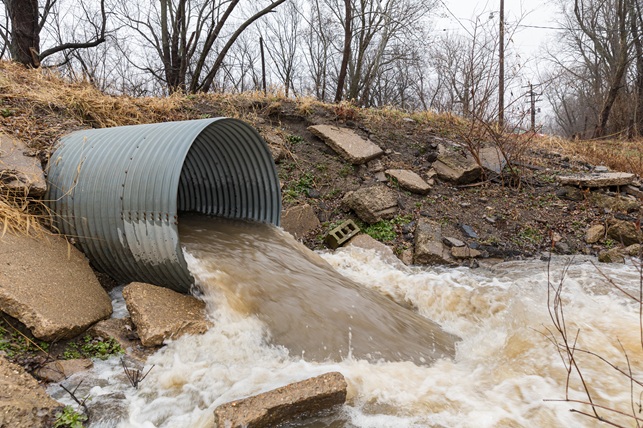
Environmental regulations have expanded dramatically across the developing world over the past two decades. However, a persistent gap remains between stringent regulatory targets and actual environmental outcomes. A central debate in environmental and development economics seeks to explain why these regulations frequently underperform and how polluters manage to skirt the rules.
The core friction lies in the severe information asymmetry between regulators and polluting firms. When enforcement systems rely on predictable or intermittent monitoring, firms will predictably find ways to circumvent them. Recent research has uncovered a phenomenon known as temporal evasion, where firms exploit man-made gaps in monitoring schedules. For instance, Zou (2021) found that US firms emit more on unmonitored days, while Agarwal et al. (2023) documented that polluters in China intensify emissions under the cover of nightfall.
But what happens when the monitoring is continuous and real-time? In our recent research (Zhao and Yuan, 2026), we contribute to this debate by documenting a novel and sophisticated form of temporal evasion: industrial firms strategically time their wastewater discharge to coincide with heavy rainfall. They do not merely pollute when regulators are not looking—they pollute when nature helps them hide.
The vulnerability of threshold-based monitoring
To understand this evasion, we first examine the architecture of modern water quality enforcement. In many countries, including China, the US, and the EU, regulators rely heavily on fixed-station surface water quality monitoring networks. Because monitoring every individual factory’s discharge pipe in real-time is often administratively burdensome or technologically infeasible, these networks serve as the primary enforcement tool.
Crucially, these systems frequently employ a high-stakes, threshold-based alarm mechanism. Stations monitor the aggregate pollution concentration in a given river or catchment area. If the concentration of key pollutants, such as chemical oxygen demand (COD), exceeds a mandated limit, an automated alarm triggers immediate administrative inspections and enforcement.
This threshold-based monitoring system has a critical yet overlooked vulnerability. Heavy rainfall significantly increases river runoff and dilute pollutants in the river, creating a massive “dilution buffer.” Polluting firms have an incentive to exploit this buffer. By releasing untreated wastewater during heavy rainfall, they can discharge large volumes of pollutants while relying on the rainwater to dilute the aggregate concentration, ensuring it remains below the regulatory alarm threshold.
Evidence of “polluting-in-the-rain”
Anecdotal reports have documented instances of this “polluting-in-the-rain” phenomenon—typically when foul odors or visible discoloration of emitted wastewater prompts complaints from local residents. A critical overlooked and unanswered question is how prevalent is this strategic emission behavior across China? Moreover, if these practices are occurring on a large scale, to what extent do they undermine the aggregate effectiveness of the country’s environmental regulations?
In our paper, we answer this question by leveraging comprehensive datasets from China. We combine high-frequency, daily water quality readings from 147 national automated monitoring stations with localized precipitation data from 2014 to 2019. This allows us to observe the dynamic behaviors of polluting firms located upstream of these monitoring stations across thousands of rainfall episodes.
The data reveal a striking divergence. We classify monitoring stations into “treatment” groups (catchment areas densely populated by upstream polluting firms) and “control” groups (areas with minimal industrial activity).1
Figure 1. COD concentration within a rainfall episode
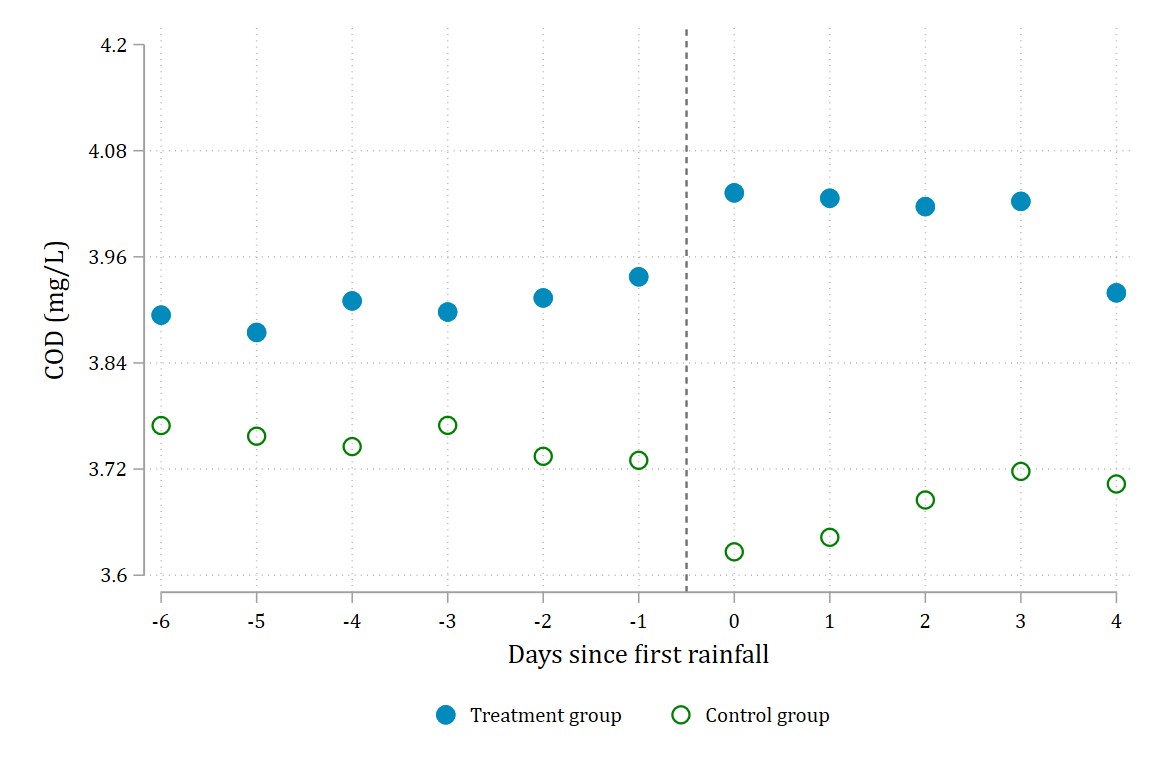
Note: This figure illustrates the average COD concentration during a rainfall episode, with day zero representing the “rain day” (daily precipitation exceeding 15 mm). The episode spans six days before and four days after the rain day. Blue solid circles denote observations from treatment-group monitoring stations (with upstream polluting intensity above the median), while green hollow circles represent control-group stations.
As shown in Figure 1, during dry periods, water quality remains stable and parallel across both groups. However, when heavy rainfall hits (Day 0), the trends diverge sharply. In areas with minimal upstream industrial activity, pollution levels decline post-rainfall, reflecting the expected natural dilution effect of rain. In stark contrast, catchment areas with a high density of upstream polluting firms experience a significant increase in COD concentrations.
This post-rainfall pollution spike in heavily industrialized areas points directly to deliberate, strategic evasion. Firms take advantage of the rain’s dilution effect, releasing enough wastewater to overwhelm the natural cleansing capacity of the river. To validate that the observed pollution spike is attributable to industrial firms’ deliberate discharge rather than confounding factors, we have conducted a battery of analyses to rule out alternative explanations, such as the washout of preexisting pollutants and surface runoff carrying nearby agricultural and residential waste.
Interestingly, we find that this evasion does not stem from firms ramping up production during rainstorms to emit “on the spot.” Instead, firms employ a covert “store-then-discharge” strategy. Facilities equipped with high-capacity wastewater storage tanks stockpile untreated effluent during dry days and simply open the valves when it rains, decoupling their emission strategies from their production schedules. Such a “store-then-discharge” strategy was previously documented by news reports, which motivated our initial investigation.2
The limits of top-down deterrence
Firms weigh the costs of treating wastewater internally against the risks of getting caught. Our analysis shows that firms facing higher compliance costs are much more likely to engage in this behavior. But how do they respond to heightened enforcement risks?
To answer this, we examine the impact of China’s central environmental inspection teams, a powerful, top-down initiative that dispatches national inspectors to conduct intensive, month-long audits of local governments.
Figure 2. Dynamic effects before and after the arrival of central inspection
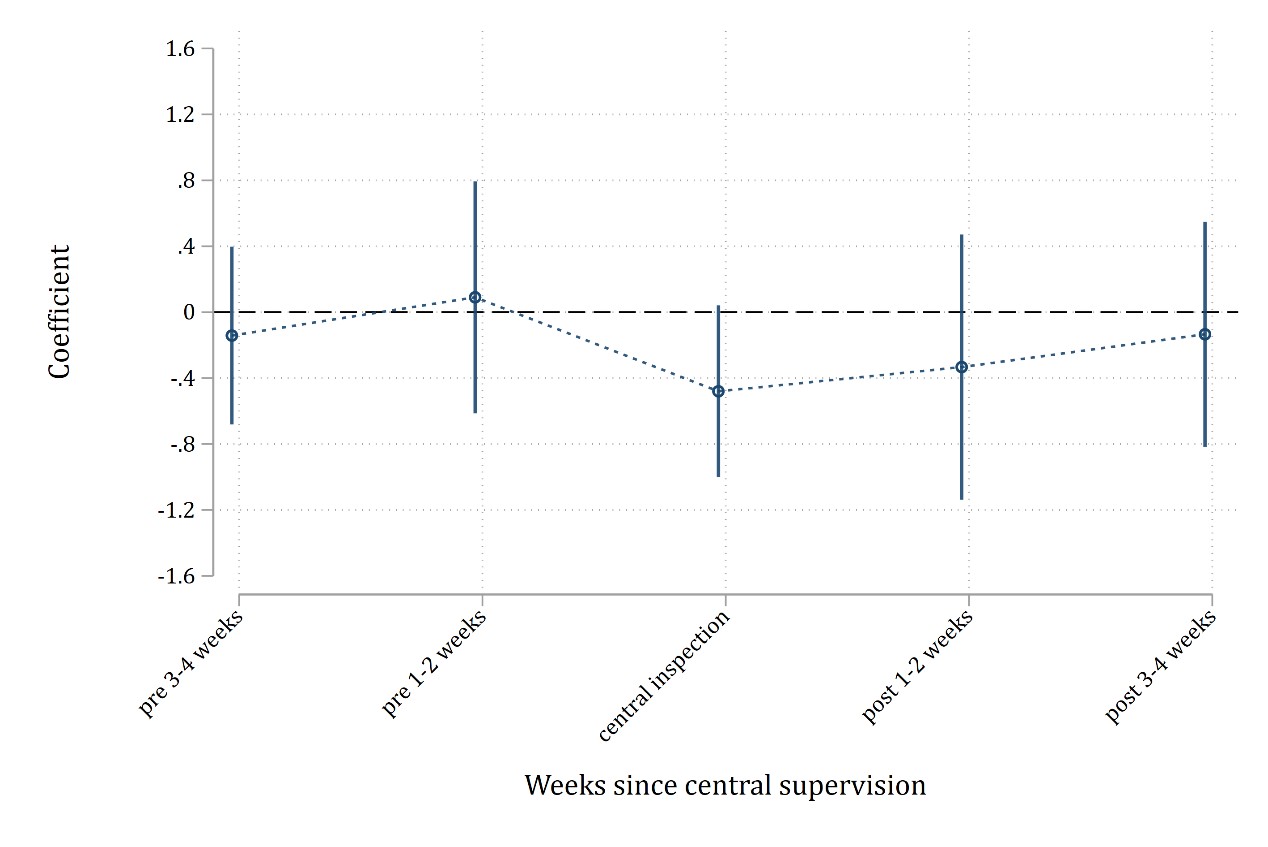
Note: The figure illustrates the dynamic response of firms’ strategic discharge behaviors to the arrival of the central inspection team. The sample is restricted to five intervals: 3–4 weeks before the inspection, 1–2 weeks before the inspection, the month of the inspection, 1–2 weeks after the inspection, and 3–4 weeks after the inspection. Coefficient estimates of “polluting-in-the-rain” intensity for each sub-interval are plotted alongside their 95% confidence intervals.
Figure 2 demonstrates an immediate yet transitory reduction in rain-day discharge upon the arrival of central inspectors. During the inspection month, the strategic discharge behavior drops sharply, indicating a strong deterrent effect. However, this response is short-lived: the effect dissipates rapidly after the inspection concludes, with evasive behaviors reverting to the pre-inspection baseline within a month. This “window-dressing” behavior highlights the limitations of relying solely on periodic, top-down inspections to address dynamic evasion.
Policy implications: The cost of covert emissions
These findings carry profound implications for the design of environmental policy. The volume of this covert pollution is staggering. Through a back-of-the-envelope calculation, we estimate that total rain-day COD emissions along China’s major rivers amount to approximately 75,000 tons annually.
To put this in perspective, these strategic discharges are large enough to offset 43% of the Chinese government’s national industrial COD reduction targets set during the 13th Five-Year Plan (2016–2020). Consequently, officially observed reductions in water pollutant concentrations overstate the actual emission reductions achieved. Although in practice the aggregate water quality at the monitoring stations might not really trigger the regulatory alarm, this compliance is illusory: while the threshold-based system was primarily designed around dry-weather self-purification capacity, it insufficiently anticipated that firms would exploit rainfall's dilution effect to discharge far greater volumes of untreated wastewater—including hard-to-degrade and potentially toxic effluents—into waterways undetected. Using nature as a free disposal facility imposes real public health costs, as excess pollution degrades drinking water safety, agricultural irrigation, and aquatic ecosystems, masking harms that are substantial and socially unjustifiable despite appearing acceptable on a monitoring dashboard.
To close this enforcement gap, policymakers must recognize the fundamental limitation of a threshold-based monitoring system to deter sophisticated evasion, particularly when natural volatility creates temporary blind spots.
The policy response requires accelerating the deployment of real-time, end-of-pipe monitoring directly at the emission source. Tracking exactly what leaves a factory’s discharge pipe in real-time eliminates the cloak provided by the weather. Furthermore, as climate change intensifies the frequency and variability of extreme rainfall globally, the opportunities for this type of dilution-based evasion will only expand. Environmental regulations must evolve from static threshold targets to dynamic enforcement systems capable of addressing both polluters’ evasive behaviors and environmental volatility.
1 See a news report.
2 See a news report.
References
Agarwal, Sumit, Yajie Han, Yu Qin, and Hongjia Zhu. 2023. “Disguised Pollution: Industrial Activities in the Dark.” Journal of Public Economics 223: 104904. https://doi.org/10.1016/j.jpubeco.2023.104904.
Zhao, Runhao, and Ye Yuan. 2026. “Strategic Emissions in the Rain.” Journal of Development Economics 181: 103731. https://doi.org/10.1016/j.jdeveco.2026.103731.
Zou, Eric Yongchen. 2021. “Unwatched Pollution: The Effect of Intermittent Monitoring on Air Quality.” American Economic Review 111 (7): 2101–26. https://doi.org/10.1257/aer.20181346.

Latest
Most Popular
- VoxChina Covid-19 Forum (Second Edition): China’s Post-Lockdown Economic Recovery VoxChina, Apr 18, 2020
- China’s Great Housing Boom Kaiji Chen, Yi Wen, Oct 11, 2017
- China’s Joint Venture Policy and the International Transfer of Technology Kun Jiang, Wolfgang Keller, Larry D. Qiu, William Ridley, Feb 06, 2019
- The Dark Side of the Chinese Fiscal Stimulus: Evidence from Local Government Debt Yi Huang, Marco Pagano, Ugo Panizza, Jun 28, 2017
- Wealth Redistribution in the Chinese Stock Market: the Role of Bubbles and Crashes Li An, Jiangze Bian, Dong Lou, Donghui Shi, Jul 01, 2020
- Evaluating Risk across Chinese Housing Markets Yongheng Deng, Joseph Gyourko, Jing Wu, Aug 02, 2017
- Daily Price Limits and the Magnet Effect Ting Chen, Zhenyu Gao, Jibao He, Wenxi Jiang, Wei Xiong, Oct 25, 2017
- What Is Special about China’s Housing Boom? Edward L. Glaeser, Wei Huang, Yueran Ma, Andrei Shleifer, Jun 20, 2017
- Privatization and Productivity in China Yuyu Chen, Mitsuru Igami, Masayuki Sawada, Mo Xiao, Jan 31, 2018
- How did China Move Up the Global Value Chains? Hiau Looi Kee, Heiwai Tang, Aug 30, 2017