
A Bridge on Economic Issues between China and the World



 Facebook
  Twitter
  Instagram
 WeChat
  Email
Email Integrating Jurisdictions, Dividing Workers: Consolidation, Labor Markets, and the Migrant-Local Wage Gap in China
We examine how China’s recent wave of city-county mergers reshaped local labor markets. Using individual-level data from the China Migrants Dynamic Survey and a staggered difference-in-differences approach, we find that the reform boosted wages by strengthening local economies and improving governance. In merged jurisdictions, connectivity improved, tax enforcement became more effective, and access to local services expanded, reflecting genuine administrative integration. Yet the labor market gains were not uniform, with local residents benefiting more strongly than migrants, revealing how political consolidation can promote growth while altering its distribution across workers.

How large should a jurisdiction be? This question is a classic and enduring one in political economy. For decades, scholars have debated the trade-offs between the benefits of decentralized, local governance and the economies of scale that come with larger, more centralized administrative areas (Alesina and Spolaore 2003, Redding and Sturm 2008). In many developing and emerging economies, a key concern is that smaller, fragmented jurisdictions can lead to local protectionism and administrative barriers that stifle economic integration and growth (Bazzi and Gudgeon, 2021). Consequently, many governments have pursued policies of jurisdictional consolidation.
In China, a wave of such reforms since the 1980s has focused on administrative integration, aiming to break down internal barriers and create more unified and efficient metropolitan markets. Recent research, such as Han and Wu (2024), confirms that these reforms can spur aggregate economic development and improve firm performance. Yet, while we know that such mergers can boost growth, less is known about what they mean for the people living and working in these areas. Do the benefits of consolidation flow equally to everyone? This question is particularly salient in the Chinese context, which is characterized by a highly mobile labor force of migrant workers who often face different opportunities than local residents (An et al. 2024, Zhang et al. 2024).
In our recent paper (Bo and Wang, 2025), we investigate the labor market consequences of one of China’s most significant consolidation reforms: the “city-county merger” (known in Chinese as chexian shequ), beginning in 2000. This policy converts administratively independent counties, which traditionally had significant autonomy over local affairs, into urban districts under the same prefecture government. The change effectively transfers control over urban planning, land supply, and infrastructure from the county to the prefecture level. These consolidations are not locally determined; they are top-down decisions ultimately approved by the central government based on criteria regarding a county’s population size and shift toward nonagricultural employment. Furthermore, we show that the time lag between the initial proposal and final approval is not correlated with county-level characteristics such as GDP or population density, allowing us to treat the rollout as a quasi-natural experiment. Between 2011 and 2018, a total of 142 counties in 98 prefectures underwent city-county mergers, providing a large-scale natural experiment to study the effects of political consolidation. Figure 1 illustrates an example geographically.
Figure 1. Illustration of the reform: Shiyan prefecture and Xiangyang prefecture, Hubei
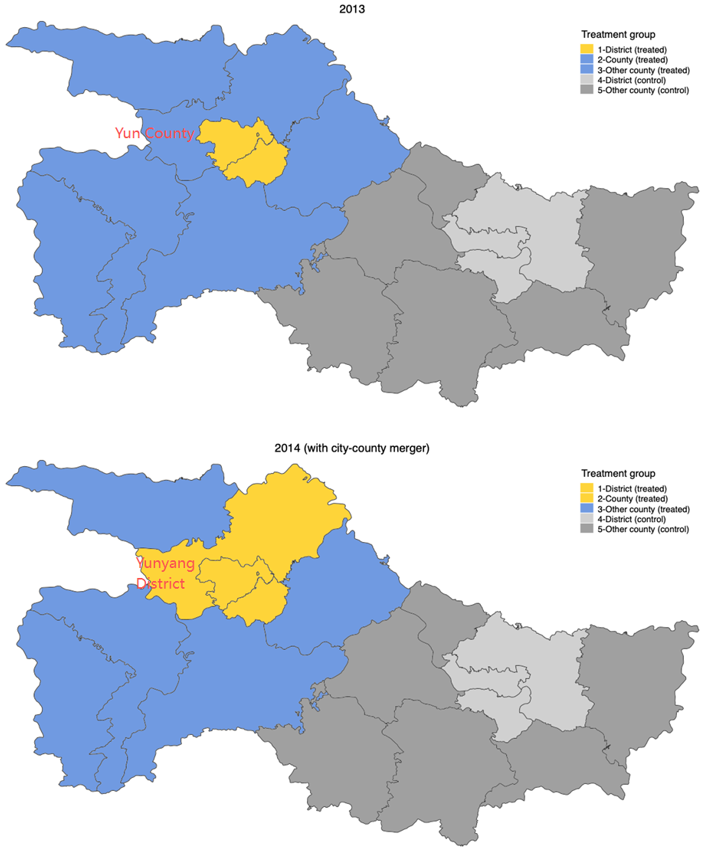
Notes: The blue/yellow-shaded area on the left is Shiyan Prefecture (treatment group), and the gray-shaded area on the right is Xiangyang prefecture (control group). During the merger reform in 2014, Yun County in Shiyan Prefecture was converted into Yunyang District and merged with the Shiyan metropolitan area. Neighboring Xiangyang Prefecture (gray) serves as a comparison prefecture not affected by the reform.
Using detailed pooled cross-sectional, individual-level data from the China Migrants Dynamic Survey and a staggered difference-in-differences (DID) design, we compare wage outcomes for workers in prefectures that underwent the reform with those that did not. Our findings reveal a story of both success and divergence. On average, consolidation works. The reforms led to local economic growth and real wage increases for workers, confirming that breaking down administrative barriers and integrating governance can generate tangible economic benefits. However, these benefits are far from evenly distributed. When separating workers into two groups—migrant workers (those without local hukou) and local residents—a stark gap emerges. We find that the city-county mergers increased the wages of local residents by a substantial 10.4%, while those of migrant workers rose by only 3.1%. In short, while the policy was a rising tide, it lifted the boats of local residents more than three times as much as those of migrant workers, widening the preexisting wage gap.
To confirm that the observed wage gains are robust and genuinely driven by the merger reform, we conduct an event-study analysis and a series of robustness checks following the recent staggered DID literature (Figure 2). The results remain consistent when refining control groups to improve comparability and reduce spillovers.
Figure 2. Dynamic effects of city-county mergers on wages using multiple DID estimators
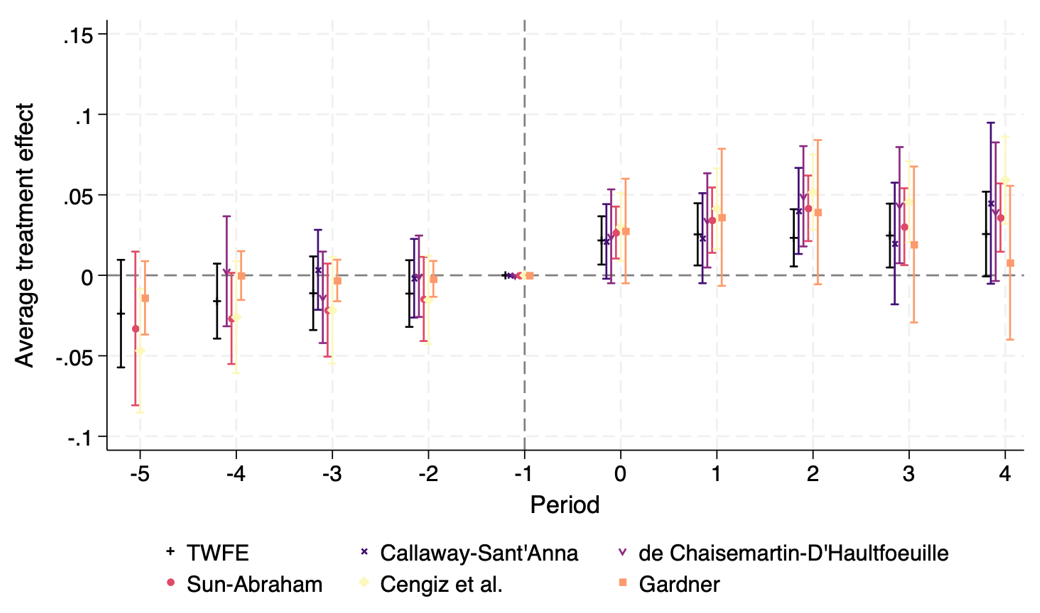
Notes: This figure shows how city-county mergers affected migrant workers’ wages over time, based on an event-study analysis with five robust DID estimators.
To further verify that the consolidation (the merger of counties with existing urban districts) was real and effective rather than recategorization (the conversion of counties into urban districts), we provide several supporting pieces of evidence. In merged areas, transport connectivity improved (measured by reduced travel times from counties to city centers), tax enforcement became more efficient (reflecting better governance), and it even became slightly easier for migrants to obtain a local hukou. Existing urban districts also showed measurable gains, which can be attributed directly to consolidation. Together, these findings confirm that the reform led to genuine administrative integration and institutional consolidation.
Why, then, did the policy benefit local residents more? One possibility is a supply-side story—that booming urban districts attracted a fresh influx of migrants, suppressing their wage growth through increased competition. However, our analysis rules this out: changes in labor supply or migrant composition cannot explain the widening gap. Instead, the evidence points to an uneven labor demand shock. Economic growth from the consolidation was concentrated in construction, infrastructure, and public services, which primarily employ local residents. The reform made investments in transportation and improvements in fiscal capacity disproportionately benefit these sectors, while areas with higher migrant concentration, such as private services, saw smaller gains.
The lesson for policymakers is clear. Jurisdictional consolidation like China’s city-county mergers can be a powerful tool for overcoming market fragmentation and unlocking economic growth, but these policies are not distributionally neutral. Without careful design, growth-oriented reforms can inadvertently exacerbate inequality by favoring certain segments of the workforce over others. As governments continue to pursue administrative consolidation, they must also ensure that growth becomes more inclusive—making new investment and job opportunities accessible to all, including the migrant populations who are essential to the urban economy.
References
Alesina, Alberto, and Enrico Spolaore. 2003. The Size of Nations. MIT Press.
An, Lei, Yu Qin, Jing Wu, and Wei You. 2024. “The Local Labor Market Effect of Relaxing Internal Migration Restrictions: Evidence from China.” Journal of Labor Economics 42 (1): 161–200. https://doi.org/10.1086/722620.
Bazzi, Samuel, and Matthew Gudgeon. 2021. “The Political Boundaries of Ethnic Divisions.” American Economic Journal: Applied Economics 13 (1): 235–66. https://doi.org/10.1257/app.20190309.
Bo, Shiyu, and Yi Wang. 2025. “The Labor Market Outcomes of Jurisdictional Consolidation: Evidence from City-County Mergers in China.” Journal of Urban Economics 149: 103788. https://doi.org/10.1016/j.jue.2025.103788.
Han, H. and J. Wu. 2024. “Jurisdictional Consolidation and Economic Growth: Evidence from City-County Mergers in China.” Journal of Economic Geography 24 (1): 123–48.
Redding, Stephen J., and Daniel M. Sturm. 2008. “The Costs of Remoteness: Evidence from German Division and Reunification.” American Economic Review 98 (5): 1766–97. https://doi.org/10.1257/aer.98.5.1766.
Zhang, Wenjie, Xianqiang Zou, Chuliang Luo, and Lulu Yuan. 2024. “Hukou Reform and Labor Market Outcomes of Urban Natives in China.” Journal of Population Economics 37 (2): 1–41. https://doi.org/10.1007/s00148-024-01027-6.

Latest
Most Popular
- VoxChina Covid-19 Forum (Second Edition): China’s Post-Lockdown Economic Recovery VoxChina, Apr 18, 2020
- China’s Great Housing Boom Kaiji Chen, Yi Wen, Oct 11, 2017
- China’s Joint Venture Policy and the International Transfer of Technology Kun Jiang, Wolfgang Keller, Larry D. Qiu, William Ridley, Feb 06, 2019
- The Dark Side of the Chinese Fiscal Stimulus: Evidence from Local Government Debt Yi Huang, Marco Pagano, Ugo Panizza, Jun 28, 2017
- Wealth Redistribution in the Chinese Stock Market: the Role of Bubbles and Crashes Li An, Jiangze Bian, Dong Lou, Donghui Shi, Jul 01, 2020
- Evaluating Risk across Chinese Housing Markets Yongheng Deng, Joseph Gyourko, Jing Wu, Aug 02, 2017
- Daily Price Limits and the Magnet Effect Ting Chen, Zhenyu Gao, Jibao He, Wenxi Jiang, Wei Xiong, Oct 25, 2017
- What Is Special about China’s Housing Boom? Edward L. Glaeser, Wei Huang, Yueran Ma, Andrei Shleifer, Jun 20, 2017
- Privatization and Productivity in China Yuyu Chen, Mitsuru Igami, Masayuki Sawada, Mo Xiao, Jan 31, 2018
- How did China Move Up the Global Value Chains? Hiau Looi Kee, Heiwai Tang, Aug 30, 2017